RSS

Christmas with your fiction characters

Link to Sharon A.'s book on amazon.com

Link to Sharon A.’s book on amazon.com

I do like Christmas on the whole…. In its clumsy way, it does approach Peace and Goodwill. But it is clumsier every year.

– E.M. Forster

How do the characters in your novel and short stories spend Christmas? Or do they even celebrate Christmas or any of the other cultural traditions for this time of year? (I’m using “Christmas” generically here.) Maybe you don’t actually set your stories at Christmastime, but it doesn’t hurt to imagine how your fictional characters do Christmas – even write it down – because Christmas can bring out the best and the worst of everyone in real life. And so it should in fiction.

None of my short stories in Beyond the Tripping Point are set at Christmas time, so I’m not sure what that says about me. However, if the fraternal twins, Dana Bowman and Bast Overture (“Gone Missing,” “Saving Grace,” “Digging Up the Dirt,” and “Road Raging”) were to celebrate Christmas, they probably would go to Christmas Mass for the first time in years (and you’ll have to buy the book and read the stories to see why). Great Aunt Doris would make one of her crash-unexpected visits and that would put a damper in the celebrations for Dana, Bast but maybe not Dana’s son David. The Great One, as she is called, is at loggerheads with Dana and Bast but gets along with David. I envision her coming with them to Christmas Mass and surprising Dana with her singing voice when singing the hymns, albeit singing in her gravelly voice. She’ll interfere with Bast and his Christmas cooking and the present unwrapping might turn into a free-for-all. It might end up with no one speaking or all learning something from the shared experience. And my forte being mystery fiction, there would be a murder, a robbery (maybe someone stealing the Christmas church collection) or some crime that the twins, with David’s help, and Great Aunt Doris’ meddling, would solve.

So you can see how imagining your fictional characters’ Christmas can help develop your characters. And maybe just create another story or chapter in your novel.

At this time, I want to wish you all a good holiday season (Christmas or whatever you celebrate). Take some time for family and friends, and for yourself and your writing.

Meantime, click on the book graphic above to link to my book (print or Kindle) at amazon.com

Cheers.

Sharon A. Crawford


Tags: , , , , , , , ,

Blog tours for your writing and your book

 book cover Beyond the Tripping Point

Click on book cover to get to amazon.com link to my book

Without promotion something terrible happens…nothing.

–          P.T. Barnum
I’ve been busy writing guest spot blog posts or doing blog tours as they are called. This is a great way to promote your published book. However, it also can work to promote your writing and to do a writing feedback exchange. Blog tours can expand your blog’s readership and create new connections. And we writers working in isolation need to connect.

Connecting with other writers not only gets you out of this aloneness but it can be of mutual benefit to you and your connections. You can read what others are writing and discover different writing styles, learn more in different areas (we writers are supposed to be curious), possibly get some writing feedback going back and forth and perhaps some guest blog posting.

A writer friend, Shane Joseph, has come up with a unique way to promote his published writing on WatPad  http://www.wattpad.com/. And  he will also be a featured writer on WatPad  December 14. Direct link to Shane’s work is http://www.wattpad.com/8704102-lest-they-be-forgotten-foreword

My two guest blog posts coming up this month do help promote my short story collection Beyond the Tripping Point, but they also provide details on how and why I write. One post, set up in Q and A style, covers how my writing career evolved and provides a way to share some of the joys and pitfalls of writing – I also like to read about other authors and how they are evolving. In another guest blog I go into my writing name identity crises. Any writer who uses or considers using pseudonyms can relate to this issue.

I suggest you read other writers’ blogs and comment. Connect.

Check out these links:

Shane Joseph on Watpad http://www.wattpad.com/8704102-lest-they-be-forgotten-foreword

My two upcoming blog tours:

The name post – What’s in a Name? Going live December 15, 2012 at http://typem4murder.blogspot.ca/

Q and A – Going live December 28, 2012 at http://sweatercursed.blogspot.ca/

Happy reading and connecting.

And for Canadians, Beyond the Tripping Point is now available in print and Kindle from amazon.ca – direct link http://www.amazon.ca/Beyond-Tripping-Point-Sharon-Crawford/dp/0986952893/ref=sr_1_1?s=books&ie=UTF8&qid=1355327652&sr=1-1

Cheers.

Sharon A. Crawford
 

Tags: , , , , , , , , , ,

When your fiction characters take over your mind

Beyond the Tripping Point Cover 72dpiA novelist is a person who lives in other people’s skins.

–       –    EL Doctorow

I’m rewriting the prequel novel to four linked stories in my short story collection Beyond the Tripping Point (Blue Denim Press, 2012). The main characters are the fraternal twin PIs Dana Bowman and Bast Overture, Detective Sergeant Donald Fielding, Great Aunt Doris, and Dana’s son, David. They appear in some or all of those linked stories and also in the novel I’m rewriting.

Trouble is one of the suspects in the novel has climbed inside my head and demands to be heard – loud and clear. I can see clearly what he looks like and does and I’ve already written him into some chapters, even given him his own Point of View, but he is still not satisfied. It is his story as much as it is the other characters’ story..

So I made some notes to go with the “old novel version chapters” and Friday afternoon I sat down at my computer and started a full-blown character sketch of this fellow. The sketch, when completed, will contain everything from what he eats (or doesn’t eat) for breakfast, to his sordid past, to his feelings and actions for the novel’s time. Not all, but some of this will be incorporated into the novel, bit by bit (without revealing his name until the police and PIs get up to speed about him). He will also get more novel time. After all, I don’t want him coming after me.

So, what do you do if one of your fiction characters seems to be taking over your mind to the point where you do your version of the absent-minded professor? Besides your mind swirling around like it’s going through space, not paying attention to the present/to what is happening can be dangerous. You don’t want to cross the street right in front of an oncoming car or burn dinner to the point where it sets your house on fire.

To give your demanding character his or her due, you need to do the following:

  • Acknowledge the character and his or her right to be in your short story, novella or novel
  • Do an in-depth character sketch – preferably on computer or on paper. You know the old saying about writing it down – doing so not only shows its relevance, but it gets all those swirling thoughts and ideas out of your head and into a more permanent record – at least one easier to access and review. Your head will thank you.
  • What is in a detailed character sketch? You character’s name, background (family, education, current job if he or she has one), physical characteristics, likes, dislikes, traits, What makes him or her angry, sad, happy, etc. What is his driving force in life? In other words all the stuff that he is and what makes him tick?
  • It helps to give this character a tag, i.e., something (or a few somethings) he does when nervous (become irritable, jingle change or keys in pocket, etc.), and something he does or says across the board. For example, he may always use the f-word or have a particular way of handling phone calls (talk to the point and hang up abruptly). Perhaps the character may have multiple allergies and constantly sneezes. The “tag” or “tags” should be something that becomes part of your story.
  • Caveat One: You can get carried away doing character sketches (or the reverse). The former is better because you won’t use it all in your story, and may use very little in your short story. But having full insight into your character and on paper, helps when you sit down in front of your computer to write your story. You feel as if your character is an old friend or old enemy.
  • Caveat Two: As you write your novel or short story, you may be inspired to add more to your character sketch or change something. Do so if it would work better. A character is constantly changing – just like real characters in real life.

Do any of you who are writing fiction have characters taking over your life? How do you deal with these demanding individuals?

Cheers.

Sharon A. Crawford
 

Tags: , , , , , , , ,

Point of View – Part 4 – The “God” POV

Cover of Sharon A. Crawford’s mystery short story collection

Easy reading is damn hard writing.

–          Nathaniel Hawthorne

The omniscient point of view is sometimes called the “God point of view” because it is the point of view that is see all, hear all and know all. Here, besides various characters’ POV you get the narrator jumping in. The narrator or “God” can do things like give background of a setting or other information that none of the characters would know. The omniscient POV also lets the author step back a little from getting too close to his or her characters, although the latter isn’t obligatory. The author may get close to his protagonist and antagonist.

Just to muddy the omniscient waters more, the rule of one character’s POV per scene (or per chapter if chapters aren’t divided into scenes) still applies, although some proponents of the omniscient POV disagree and say you can be in all characters’ heads at once.  “God” maybe is able to be everywhere at once, but your reader can’t with one exception – that narrator or “God” can work in those setting details – you know the type where one character drives into a town he has never visited and more than just what he can see and know is narrated (town’s history, for example).

When to Use Omniscient POV

You can best get your message across and further your plot by revealing many characters’ thoughts, and feelings.

When your story can’t be told from one person’s point of view because of actions occurring in the plot.

When your story needs information that none of the characters would have knowledge of.

In novels that cover several time periods and that have several characters.

In a nutshell, the author knows all/sees all understands all of what each character thinks, imagines, knows, feels.

It’s complicated.

What Isn’t Omniscient POV

First let’s cover what isn’t omniscient POV, but uses a technique not too common – mixing up first person and third person. Mystery writer Bill Pronzini does this in his “Nameless” detective novels. His earlier novels were told from the first person only and Nameless was just that. In later novels, Pronzini has three POV characters – Nameless (who has a first name now) and two other private investigators in the agency. Nameless is told from the first POV and the other two are in the third person. He sticks to the one character’s POV per chapter and puts the name of the third person POV at the beginning of the chapter. Nameless chapters don’t get this subheading because readers should be able to tell from the first person usage who the character is. Pronzini does this very well.

Omniscient POV in Short Stories

Omniscient, per se, isn’t usually used in short stories, although a variation of it can be used. You can have your narrator come in at the beginning with information about the story, the characters, the setting, etc. but at some point you have to focus on one character’s point of view. Because short stories are supposed to be well, short, you probably shouldn’t use more than two points of view, but no jumping heads – one character’s POV per scene. Otherwise you have the inside of the reader’s head jerking back and forth and getting confused. You do not want your reader to be confused – confused readers give up reading a story (or a novel).

Omniscient POV in Novels.

I use a variation of omniscient POV in my prequel mystery novel which I am writing now. I say “variation” because I put one character, Dana Bowman, in the first person and other main characters’ POV in the third person. I name the POV character at the beginning of the chapter or scene, but unlike Bill Pronzini I do put “Dana” for the first person POV character. However, for obvious reasons, I put nothing at the beginning of chapters with the POV of a maybe suspect.

Dana is put in the first person because she is the character I want the reader to get closest to. She always wears her emotions on her sleeve. Her fraternal twin Bast Overture is in third person for two reasons. He is not so forthcoming in his feelings, even in his own mind, and I want to show the reader this. The other main characters I get close to in varying degrees, but none as close as Dana.

As for the narrator jumping in to do the scene descriptions, etc. I’m still working on that or if I want it strictly from specific characters point of view. I’m leaning towards the latter and there is a technique in that which I’ll cover in a future post.

Meantime, read the beginning of my short story “No Breaks,” and see if you can figure out the Point of View and why? Is it third person limited or is it omniscient?

It’s a scummy Saturday morning and Highway 11 resembles fast food parking hell. If you’re making your last ditch scramble for your reserved spot in the Muskokas, try an alternate route.”

“Yeah, what alternate? Highway 400 is worse.” Millie Browne yells back at the radio announcer. She clicks off the radio.

Most of these Saturday drivers probably have air-conditioned cars. Millie isn’t blessed with air-conditioning. She isn’t blessed. She can’t even remember whether she was baptized as an infant, but today she’s going to remedy that.

Today, on this heat-infested highway, Millie desires only one thing: an even break in life. To obtain this end she plans to jump in the lake. She’s not sure which Muskoka lake but she doesn’t care. It won’t be Baptism by fire, but Millie figures the cold water will clear her head and bring some control back into her life.

Control is Millie’s keyword. She’s organized her life every day from senior year in high school. Her diaries (the truth) speak in contrast to her calendar (the plan).

Not so Jessica Myers, age 30, sitting beside Millie and thumbing on her BlackBerry… (excerpted from Beyond the Tripping Point, copyright 2012 Sharon A. Crawford, published by Blue Denim Press)

Cheers.

Sharon A. Crawford


Tags: , , , , , , , , , , , ,

POV – First person or third person – Part 3

Cover of Sharon’s book Beyond the Tripping Point

My task, which I am trying to achieve is, by the power of the written word, to make you hear, to make you feel–it is, before all, to make you see.

– Joseph Conrad, Lord Jim

So you want to get inside one person’s head (or at least one person at a time) in your story. Should you go for first person singular or third person singular?

Let’s look at how these can work.

First Person Point of View – the story is told from one character’s point of view, using “I,” “me,” “my” and “our.” The character could be a major player who is active in the novel, or the observer, as in F. Scott’s Fitzgerald’s The Great Gatsby.  Or an observer/major player, such as Archie in the Nero Wolfe mystery novels.

Anything that happens in the story must be what the character can see, hear, touch, feel, think, imagine or read. He or she can say what he sees about other characters but can reveal only his own feelings. He could imagine what the other character feels, but this must be clear. You can get around some of what sounds like restrictions by using emails, Facebook pages, Twitter – as long as it is either what the  I POV character is doing or reading. To help keep on track, picture a video camera inside this first person narrator’s head.

My short story “16 Dorsey St.” from Beyond the Tripping Point is told using emails between two sisters, Elsa and Sylvia .with newspaper clips thrown in. The POV remains with Elsa even with Sylvia’s replies. Elsa is reading them from her computer. Here’s a short example.

E-mail from Elsa to Sylvia

3/3/1997 9.07 P.M.

Subject: Newspaper story

Sylvia, something disturbing happened. The “someone” at the door was today’s newspaper and I don’t get the paper delivered. An article on the front page of section two was circled in red. I’ve scanned it and am attaching it so you can read it.

Love,

Elsa

Attachment to e-mail:

CRIME FLASHBACK—MURDER ANNIVERSARY TODAY

Today is the anniversary of one of Toronto’s most baffling murder cases. Fifty years ago, a 23-year-old woman was strangled. Lois Harkner was a honey blonde beauty, a lady who would never hurt anyone. Yet someone wanted her dead.

Harkner was found lying beside her dressing table…

(Excerpted from Beyond the Tripping Point, copyright 2012 Sharon A. Crawford, published by Blue Denim Press 2012)

When to use First Person POV

To move the plot forward, your readers need to know the main character’s inner thoughts.

You can reveal your main character best by telling the story from main character’s POV.

Revealing the conflict works best by showing the readers only the main character’s thoughts.

You want your readers to get up close and personal with your main character.

Third Person Point of View – the story is told from the narrator as “he/she” – you can use people’s names. Here the narrator is further from the story than the first person POV. In Third Person the story is told from that one character’s POV with only what he can observe, hear, etc.

Here’s the beginning of my short story “No Breaks” I combine what Millie hears on the radio with Millie’s inner thoughts.

“It’s a scummy Saturday morning and Highway 11 resembles fast food parking hell. If you’re making your last ditch scramble for your reserved spot in the Muskokas, try an alternate route.”

“Yeah, what alternate? Highway 400 is worse.” Millie Browne yells back at the radio announcer. She clicks off the radio.

Most of these Saturday drivers probably have air-conditioned cars. Millie isn’t blessed with air-conditioning. She isn’t blessed. She can’t even remember whether she was baptized as an infant, but today she’s going to remedy that.

(Excerpted from Beyond the Tripping Point, copyright 2012 Sharon A. Crawford, published by Blue Denim Press, 2012)

When to Use Third Person POV

First person POV won’t work because you need to have your narrator more distanced to report your main character’s thoughts and actions. Also use third person if first person gets in the way of showing your main character’s weaknesses. This latter is not always necessary, as some characters seem to be able to get around their egos to show and comment on their weaknesses. For example self-effacing humour, inner thoughts where they present their view as correct but they word it so you can read their weakness between the lines.

Narrator’s objectivity strengthens the main character or the story’s message.

In next week’s post we’ll go into using the omniscient Point of View as that can be complex and confusing.

Meantime, check out my short story collection and maybe purchase a copy. It is now available as an e-book. Click on the book cover above.

Cheers.

Sharon A. Crawford


Tags: , , , , , , , ,

POV Part 2 – Getting inside other characters

cover of Sharon A.’s short story collection. Click on it to get to amazon.com

Action, reaction, motivation, emotion, all have to come from the characters. Writing a love scene requires the same elements from the writer as any other.

–          Nora Roberts

Back in October we learned the cardinal rule of Point of View in fiction – do not switch character POV mid-scene or mid chapter if the chapter has only one scene. So, how do you get the POV of other characters out there without “jumping heads?”

In the previous post we discussed how, when and why to actually change the POV. But what if you want to let your reader know how Sam feels and thinks without getting inside his head?

You know the old axiom about good writing – show, not tell.

That’s how you do it.

In “The Couch,” the first story in my mystery short story collect Beyond the Tripping Point, the Point of View is that of the main character, the young private investigator, C.U. Fly. Fly has a big thing for the secretary, Annie Everglades, but the story never gets inside Annie’s head. Here’s a brief excerpt from near the story’s beginning:

“Give it up, C.U.,” she said when she found me staring at her long legs. She pushed back her wire-framed glasses and gave me an icy grey glare. “C.U. Fly, you may be a private investigator, but I am not your client.” Then she turned to her laptop and her fingers began to zip over the keys. “Your talent is listening, not looking. Go bug a client.”(Excerpted from Beyond the Tripping Point, copyright 2012 Sharon A. Crawford).

Annie’s reaction to C.U.’s unwanted advances is obvious. This is shown by her dialogue – she gives C.U some boundaries and explains the PI’s functions. There is also a bit about what C.U. is doing at the time. For the latter, notice the use of the word “me.” We also get Annie’s actions – pushing back her glasses and giving C.U. a cold stare. Then she dismisses Fly and gets back to her job.

So dialogue and actions show the reader how Annie feels towards C.U. and we didn’t get inside her head.

Here’s another excerpt from the same story.

“C.U., get your paws off my back,” she said as the three of us occupied space on the couch. At her voice, Brutus leaped over me and settled in Annie’s lap.

“Fine,” I said. “You’re in charge of dog sitting services.”

She gave me one of her frosty stares. I smiled and pretended my heart stayed at normal medical settings. I had no control over my legs and arms, so staggered up, shook myself into my denim jacket and padded down the stairs..”(Excerpted from Beyond the Tripping Point, copyright 2012 Sharon A. Crawford).

Here we have a combination of dialogue between the two characters, action, but also how the POV character, C.U. Fly feels (pretending the heart stays normal) and how Fly reacts (smiles, staggers up off the couch, puts on a denim jacket and leaves). Fly’s reactions show the reader the relationship between the two characters – they are operating from different perspectives but we also learn how Fly sees Annie and feels about her.

In summary, you can reveal what is going on with other characters in your story by:

  1. Dialogue between the POV character and the other character.
  2. Action – between the POV character and the other character or just the other character.
  3. And tying in with the above – reaction of the POV character to the other character.
  4. POV character’s feelings and beliefs about the other character.

We’ll cover using third person POV and multiples in future postings.

For now, here is my current upcoming event with my book Beyond the Tripping Point:

Tonight, November 15, 2012 from 7 p.m. to 9 p.m. I am on a panel with other recently published Canadian Authors Association Toronto Branch members, Chris Canniff and Bianca Lakoseljac. The three of us will share the ups and downs of getting from first draft to published book. Location is the Northern District branch of the Toronto Public Library in Toronto, Ontario, Canada. More details at http://www.canauthorstoronto.org/events.html Those in the Toronto area, please stop by.

And to purchase a copy of my book – now in e-book form as well as print,  for Kindle (and also a link to the print copy. just click on the book cover at the top of this post. For Kobo, click on the book cover below.

Cheers.

Sharon A. Crawford

Beyond the Tripping Point link to Kobo


Tags: , , , , , , ,

Lessons learned from the actual book launch

Sharon A. Crawford reads at the book launch of Beyond the Tripping Point

Put it before them briefly so they will read it, clearly so they will appreciate it, picturesquely so they will remember it, and above all, accurately so they will be guided by its light.

~ Joseph Pulitzer

The book launch for my debut short story collection Beyond the Tripping Point has happened.and I’m still going around in overwhelm. First off it went well – we filled the backroom of The Rivoli and everyone had a good time. The Rivoli want my publisher and his authors and the entertainment (Sunny and Shane) back next year. So, my publisher is happy.

But I learned a few things from the experience and I’m passing them along for anyone out there organizing and experiencing their first book launch. Some of the points also are pertinent for doing public reading.

First I’d like to state that I was in a state of shock and operated on automatic pilot throughout the three hours. Not from nervousness, not from the time change overnight to eastern standard time, and not even my always time-strapped life. It was a phone call from a friend earlier that morning. And if you want to find out about that you will have to read my other blog’s post this week at http://www.onlychildwrites.wordpress.com

Now on to lessons learned.

When you are on stage at a club or pub, the lights may be too good – you can see what you are reading but you can’t see beyond the lights into the audience. You have a bright-light blockage. I like to connect to my audience when I read.

The next day (and thank you Shane for waiting until the next day) the editor at my publisher’s said I had read too long with the second and last reading. For one story, I had attempted to combine reading story excerpts with filling in a few storyline gaps. My editor said he saw a few people fidgeting. (I blame this one on being in shock/autopilot as I did the practice for this at home after the phone call). However, I am taking my editor’s advice for next readings. So time yourself to the second when you practice and when onstage reading, check your watch at the beginning and glance at it a few minutes later.

Mingle more with your guests. I did a lot of mingling, going around to tables chatting with my guests during the first part of the meet and greet and signing books. Then I sat down with my son and his girlfriend to talk to them. But I invited some friends to the table and also got up a few times to talk to others. I stayed put after that, except to go onstage to read. My police consultant came up to the table just before the music started so we didn’t have time to say much. I can’t carry on a conversation over performances on stage and don’t like to talk when authors are reading. After all the readings, friends and colleagues came up to say “hello” and for me to sign their copy of my book. But I wished I could have talked to them all more. I didn’t even see my cousins from out of town until afterwards – I joined them then. My son said that now I know how it is with him when one of his bands has a CD launch. I know that people do come in late and have to leave early and that can’t be helped. One of my friends later told me she would have liked a longer mingling session.

And connected to my other blog’s post – don’t try to arrange transportation, including car pools, for anyone coming to the launch. Just give them the location and directions there.

It also helps if you get enough sleep, which I hadn’t and still haven’t lately.

Besides the photo at the top, you can go to  http://www.flickr.com/photos/writershane/sets/72157631935084560/ In the audience photo, the fellow who looks like he is napping is my son. I’m not there because I’m on stage.

And if you click on my book photo below, it takes you to Amazon.

Next week back to more of the ins and outs of writing fiction with brief information about my upcoming readings, etc.

Cheers.

Sharon A. Crawford

Cover of Beyond the Tripping Point


Tags: , , , , , , , ,

Lessons learned from a Book Promo Frenzy

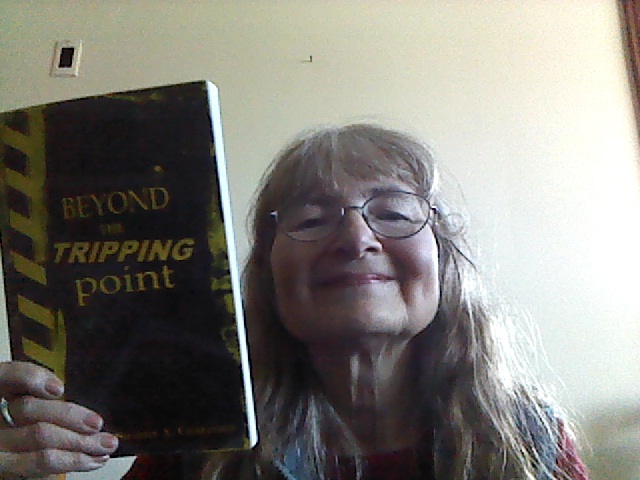
Sharon A. Crawford holding up copy of Beyond the Tripping Point

If the writing is honest it cannot be separated from the man who wrote it.

Tennessee Williams

With the windy and rainy remnants of Hurricane Sandy hitting Toronto, I wasn’t sure I would even make it to the TV taping. Didn’t get enough sleep the night before. But Sandy’s winds died down Tuesday morning and I showed up for the Internet TV interview about my short story collection Beyond the Tripping Point.

And if you are thinking, “I’m just writing my book so why would I be interested in doing interviews?”  Besides thinking ahead for the PR aspect (self-publishing or traditional publishing, you have to do PR), interviews (in front of a camera or not) can provide a good experience for you to focus on what your book is about, how you came to write it and who your characters are. I’ll cover just the highlights of my interview because once the interview is edited it should be online.

The studio is on the fourth floor of an old five-story building in downtown Toronto. The elevator didn’t look too promising so I took the stairs, went around a corner and opened the door to the studio. Everything is one room and the atmosphere is a combination of professional, friendly and helpful. I signed in, met the host and co-host, handed them a copy of my book and after their beginning preamble, I was introduced.

I wasn’t really nervous, probably because I do public speaking, readings, teach writing workshops and run a writing critique group. And I had prepared – just a brief list of what to expect from the channel’s previous podcasts, but mostly I had done practice runs in my head and verbally (Confession: I sometimes talk to myself). In the back of my mind was the editor at Blue Denim Press’s warning to try to stay on topic as the host sometimes wanders off topic.

In the 20 minutes we covered a lot of territory, including my background as a journalist, book editor and fiction writer, as well as some of the quirky characters in the story. I talked about the fraternal twin private investigators, Dana Bowman and Bast Overture in the four linked stories and the control freak protagonist in “No Breaks.” For the latter I delved into how that story came into existence – based on a true experience when a friend and I were driving up Highway 11 and her brakes failed. She was driving and knew enough to use her parking brake; we also went in and out of gas stations trying to find a bay so the brakes could be fixed. That’s where the true story ends. In “No Breaks” (the word has a double-meaning, hence the spelling), the story is told from the point-of-view (had to get POV in here somewhere) of the protagonist, Millie, who is not attractive, lost her job a few months previously, and has decided when they get up to the cottage owned by her friend, Jessica’s grandmother, she is going to jump in the lake. Things don’t go as planned and Millie, for once, goes over her tripping point and spontaneously commits a crime.

The co-host seemed to connect with my book’s characters. And the host had fun playing with some of the items I had brought along – items appearing in or used by some of the characters in Beyond the Tripping Point – an oversized magnifying glass (Great Aunt Doris in “Digging Up the Dirt”), a toy-size steam engine that sometimes starts “whoo-whoing” (“Porcelain Doll”),and a toy ambulance (“Missing in Action”). I even had a chance to read about a page and a half of one story, “The Body in the Trunk” and I could see to read from my book. In answer to a question about upcoming readings, etc. I plugged my book launch this Sunday, Nov. 4 from 2 p.m. to 5 p.m. (Eastern Standard time) at The Rivoli in downtown Toronto.

How the interview actually turned out will be seen once the edited version is up on the station’s website. It is live-streamed when being taped but the recorded version isn’t up yet, so I’m feeling a bit apprehensive. Did I curse the taping? My editor says it takes a few days for it to get edited and up.

So, back to an author with a book in-the-works being interviewed. You can do like I did years ago (back in the grey ages) in the writing courses I took. The instructor had us pair up and interview each other. For your practice interview, get someone (but not a close friend or family member – they know you too well) to interview you. If the person is in the interview biz, all the better – they can come up with pertinent questions about you and your book. You can do some prep beforehand like I did with the brief list and head/talk-to-myself practices. But the best bet is to know your book – plot and characters – and why you wrote/are writing it. You’ve been living with your book so it should be in your head. You may feel nervous but take a deep breath and go with the flow. You might even want to video record it (and perhaps put it on You Tube and connect it to your website or blog).

At any rate, the interview experience can bring you closer to your book’s characters and plot – and maybe even help you sort out any inconsistencies in plot and character. Consider it a learning experience for the real deal when you publish your book.

Meantime, check http://www.thatchannel.com later on for my interview on The Liquid Lunch. Hopefully it will be up there soon.

If you are in the Toronto area, come to my book launch at The Rivoli Nov. 4. More details at http://www.bluedenimpress.com  – click on “Toronto. Or go to http://www.amazon.com for copies of my book. O better still, click on the book cover image below.

Now please excuse me while I send out some book launch reminders and drop off a copy of Beyond the Tripping Point for review at a Toronto newspaper office.

Cheers.

Sharon A. Crawford

Sharon’s book Beyond the Tripping Point up close


Tags: , , , , , , , ,

Point of View: whose story is it anyway?

Cover of Sharon’s short story collection Beyond the Tripping Point. Book Launch Nov. 4, 2012 at The Rivoli, Toronto, Ontario,Canada

What is written without effort is in general read without pleasure

– Samuel Johnson

We writers often get into a kerfuffle about the point(s) of view in our story – short or novel. Maybe it’s because we get so caught up in the plot and characters we do a version of not seeing the forest for the trees. So in one paragraph Suzie and Bert may be talking but Suzie’s thoughts are incorporated with her dialogue and in the next Bert’s thoughts are included with his dialogue. Oops. That’s two points of view in one scene. I call it “jumping heads” (but it’s not nasty like lice).

The reader can definitely get confused with this setup (Picture the reader jumping back and forth from Suzie to Bert; hence the term “jumping heads”).

Often this problem has its roots in the author not being clear just whose story it is?

Let’s look at a brief excerpt from my short story “Gone Missing” from my mystery collection Beyond the Tripping Point. This story features the fraternal twin private investigators, Dana Bowman and Bast Overture. In the beginning, they are in their office talking to a new client.

“The police can’t find her, Ms Bowman,” Robin Morgrave says to me.

Rosemary Morgrave’s gone missing and I’m putting on the brave smile for her twin brother. Robin sits on the other side of the desk in the third floor office of The Attic Agency. Only my twin brother, Bast, nodding, stops me from losing it. Ever since David my seven-year-old son was abducted last August I’ve been living in Panicville. Sure, we got David back, but how much of him returned? He follows Bast around like an investigator-in-training. His brown eyes stare right through my soul. I wish he’d just say how he feels. But since his return, David hasn’t opened his mouth except to swallow liquids and food. He doesn’t even cry. (Copyright 2012 Sharon A. Crawford.Excerpted from “Gone Missing” from Beyond the Tripping Point 2012 Blue Denim Press)

This sets the point of view for this story. Although it might appear to be Robin Morgrave’s story from the beginning dialogue, the second paragraph clearly lets us know that it is Dana’s story – because behind dealing with Robin’s case, Dana is still dealing with the fallout from her own son’s kidnapping and how that affects finding Rosemary. That will be following throughout the story. So, the Point of View is with Dana. You can also see that you don’t necessarily have to start the story with something said about, some narrative about, or something said by the POV character. You can weave it in – as long as it stays in that character’s POV and comes across as such.

So, how do you decide whose point of view to tell your story from? You ask yourself “whose story is it?” which can help… somewhat. There are exceptions, such as Scott Fitzgerald’s The Great Gatsby, which is not told from The Great Gatsby’s point of view but from his friend. However, the story is basically about Gatsby. It can get tricky.

There is a way to get around this “whose story is it” when the novel is really more than one character’s story or the story is about something such as catching a serial killer. The latter may involve a couple of police officers, the victim or victims, and even the serial killer. Here you are allowed to use multiple points of view. But there are guidelines. The rule of thumb is each chapter or each scene (if you have more than one scene in a chapter) must be from the point of view of one character only. When you start another chapter you can change the point of view. You just leave a double space to show scene changes.

Short stories are usually told from one point of view, but again there are exceptions. However, it is best to keep it to two points of view maximum as a short story has limited space in which to tell your story. Again, you can use the scene change set-up to go from one character’s point of view to another character’s. You can also segue from one character to another – once – in a scene, not a constant flipping back and forth. This latter is more difficult to do.

My short stories in Beyond the Tripping Point keep to one character’s point of view – sometimes in first person and sometimes in third person. We’ll cover that aspect in a future post. Now, in the rewrite of a prequel novel (to “Gone Missing,” “Saving Grace” and the other two linked stories in Beyond the Tripping Point) I use multiple points of view. You can probably guess from the beginning of “Gone Missing” above what the novel is about. But because it’s a novel with police officers, two private investigators, a little boy and others, I’m focusing on the bigger picture of the story line and how it affects not only Dana, but other key players. My technique here is to put the character’s name at the top of the scene/chapter for point of view – mainly because I put Dana in the first person and everyone else in third person. And yes, I use the scene change technique.

In another post we will also look at some tricks to “get inside” the non POV characters without jumping heads and staying with the POV character.

What is my story now? I’m busy doing pre-book launch PR for Beyond the Tripping Point. That includes an interview appearance on a podcast TV show. It’s been awhile since I’ve been in front of a video camera (or behind one) so we’ll see how it goes. I’ll report in the next blog.

For information on my book launch (it’s November 4, 2012) go to http://www.bluedenimpress.com and click on “Toronto.”

Cheers.

Sharon A. Crawford


Tags: , , , , , , ,

Connecting with publishers and agents

Cover of Sharon’s short story collection Beyond the Tripping Point

To write what is worth publishing, to find honest people to publish it, and get sensible people to read it are the three great difficulties in being an author.”

~ Charles Caleb Colton

Last week I blogged about the traditional way to pitch your book manuscript to publishers and agents. Other ways exist and for some you have to have imagination and nerve. Then there is what Brian Henry said in his workshop last Saturday “Luck” or as I see it – “right place, right time.”

How I got my publisher for my mystery short story collection Beyond the Tripping Point comes under the latter. The Editor at Blue Denim Press used to come regularly to my East End Writers’ (critique) Group when he still lived in Toronto. He is also a writer. Once we traded manuscripts for evaluation (although mine was a memoir, not the short story collection). When he and the other half of Blue Denim Press, his wife, the Publisher, did a presentation about Blue Denim Press and marketing books at a Canadian Authors Association Toronto branch meeting last fall, I approached them and mentioned a collection of short stories. They said send it in during January and February when they look at manuscripts. So I did – but only seven of my stories.

They were interested but needed more stories. So I was writing and rewriting stories right up to and beyond signing my contract with them (but that’s another story).  Something else I found out – the Publisher’s taste in fiction – she reads half a dozen mystery books a week – and my short stories are in that genre. Of course, it helps to write well and have something different about your manuscript. Mine isn’t called Beyond the Tripping Point for nothing. All 13 stories feature quirky characters and as I state in the PR to promote the book:

Murder, attempted murder, sexual abuse, kidnapping, missing persons, vengeance, revenge, suicide, gambling, explosions, vehicular mishaps, indignity to a dead body, even love occur. Like all life’s happenings, they affect the characters–women, men and children–in their journey through life–emotionally, sometimes damaging them, sometimes stalling them in limbo, but often forcing them to reach beyond the tripping point. And to get there, these quirky characters frequently do the absurd and the unthinkable, often with unexpected results. 

By the way, I thought of the title and the publisher loved it.

So, what can we learn from my experience besides the obvious that I did not follow convention?

  1. Network, network and network – a combination of social media and in-person works best.
  2. Network with specific targets and goals. I focused on the publishing industry – trade shows, conferences, writing organizations, and workshops. You will meet a variety of writers, publishers, agents, etc. You might just chat with them for a bit and exchange business cards. Follow up by email.You might also do more (see below).
  3. Join some of these writing organizations and attend their meetings and seminars.
  4. Talk to the people at the conferences, etc. (wallflower acting not allowed) – introduce yourself and what you write. Ask the publisher or literary agent who is the guest speaker/attending the conference, etc. if you could send a query letter/part of your manuscript. Most will say yes, but remember that doesn’t guarantee you they will publish you or represent you. It means they will read your submission (and often they will skip their guidelines and say “just email the manuscript”). Follow-up within a week or two and in your cover or query letter make sure you remind them where you met.
  5. Remember the above can be a two-way street when you network. Sometimes it includes what you can do for them. For example, with writing organizations they are always looking for volunteers. Volunteering with a writing organization can help you connect with more writers, publishers, etc. It is also a good way to learn the ins and outs of the writing business. And it looks good on your bio for future query letters, etc.
  6. Join a writing critique group – this will help you hone your writing.
  7. Social media includes: Facebook, a blog about your book, Twitter, Goodreads, Linked In.
  8. Don’t give up. My memoir is still trying to find a home. (Note: at this point Blue Denim Press publishes only fiction).

Good luck.

The book launch for Beyond the Tripping Point, presented by Blue Denim Press, will take place Sunday, November 4, 2 p.m. to 5 p.m. eastern standard time at The Rivoli in Toronto. You are invited if you can make it (well, if you are in say, Australia, maybe not). Guests are coming from northern Ontario and possibly Michigan in the USA. I am honoured and grateful to those who do come to my book launch. More details at http://www.bluedenimpress.com and click on “Toronto.”

For those too far away to attend, Beyond the Tripping Point is available at http://www.amazon.com. Just click on the book cover at the top of this post.

Cheers.

Sharon A. Crawford


Tags: , , , , , , , , , ,