RSS

What Writers Can Learn from Authors’ Readings

Cover of Sharon A. Crawford's mystery short story collection

Cover of Sharon A. Crawford’s mystery short story collection

I loved words. I love to sing them and speak them and even now, I must admit, I have fallen into the joy of writing them.

          Anne Rice

The emcee introduced me and I headed up to the podium with my book, Beyond the Tripping Point, opened the page to read, looked at the page. And the lighting was dismal – a dim way overhead light. I struggled to see what I was reading. Apparently I did okay – at least the audience heard me or so I was told.

We writers can learn a few things from attending readings by other authors or in my case from my own reading. Here I learned to always carry a printout in 14 pt. to read from in case the lights fail. To date, since then, the lights have been bright enough to read from the book.

A good writer does not necessarily make a good reader. How often have we attended a reading when the author seemed to be in a race against time (understandable as reading time limits can be as little as four minutes), the reading voice was so low we wished they used a mic or the reading was so wooden we dozed off. The latter may be combined with the author reading way too long.

Those are the negatives but they can teach authors how not to read in public.

On the positive side, I’ve learned how to do a book marketing summary, how to pick the interesting bits to read, but the most rewarding is when interaction occurs between the audience and the reader – when the audience starts asking questions about my stories’ plots and characters and when they talk about their stories.

Some of those questions have been a little disconcerting. For example, the driver trainer who asked about the car that lost its brakes in “No Breaks.” He wanted to know if it was a standard or automatic car. Duh. I hadn’t given it any thought. As the story was triggered by a ride to Ontario’s cottage country I had years ago with a friend, I just used the type of car she had – automatic. And yes, what my friend did – used the parking brakes – worked with an automatic car but even I know that there would be problems with a standard car.

But it was a wake-up call to make sure I do all my research even when the proof seems to be in the pudding.

A favourite with many audiences is how much of your stories come from real life and if you can run into trouble with that. I sometimes use a bit from life as incentive for stories and often will bend the “rules” a little. For example, in one story in Beyond the Tripping Point (and I’m not saying which story) I developed an unfriendly character loosely based on someone in my family (not a close relative) who upset me with comments about what should or shouldn’t go in my memoir. But the character wasn’t really her. You could say she inspired the one character. Ditto the nasty father in “Porcelain Doll” whose only connection to my late father was his penchant for being on time and working for the railway. My dad otherwise was entirely different – more gentle, and he certainly didn’t gamble or verbally abuse his wife and daughter. But many of my characters just show up in my head – like the fraternal twins Dana Bowman and Bast Overture – with a mixture of what I see in the world and what I would like to see. As I’ve told other writers – you do have to be careful what you put in, but also be aware that readers sometimes see themselves or people they know in your stories’ plots and characters even when they are not the character source.

And that’s a good thing because it shows you connect with your readers.

So, besides reading your own writing (published or unpublished) in public, why not go to author readings. You might not only enjoy yourself but learn something, too.

Next week I will be expanding my reading experience as I’m adapting my presentation for a grade 7 group at one of the Toronto Public Library branches. And I’m sure I’ll learn something from this younger audience. I will also be reading for adults and moderating a panel of a couple of crime novel authors. Here’s the info on the latter two.

Tuesday, May 14, 7 p.m. to 8.30 p.m.

Crime Writers of Canada Books ‘n’ Beveragesreading with nine other CWC authors at:

Turner Park Branch of the Hamilton Public Library, Hamilton, Ontario, Canada http://www.hpl.ca/events/books-and-beverages-crime-writers-canada

Thursday, May 16, 7 p.m. to 9 p.m.

Crime & Mystery Writing Panel

Moderating a panel of mystery novelists on plot and characters especially when police enter the picture. Presented by the Canadian Authors Association Toronto Branch and featuring Crime Writers of Canada authors, Toronto, Ontario, Canada.

Panelists:

  • Brent Pilkey, author of the Rage novels who, as a police constable with Toronto Police Services, has an inside view of police procedure; and
  • Rick Blechta, whose novels aren’t exactly cozies — all have main characters involved in the music industry and when murder enters their lives, come into contact with the police.

More info http://www.canauthorstoronto.org/events.html

Check out more May readings, etc. at http://www.samcraw.com/Articles/BeyondtheTrippingPoint.html

Cheers.

Sharon A. Crawford


Tags: , , , , , , , , ,

Importance of Seasons and Days in Story

Cover of Sharon A. Crawford's mystery short story collection

Cover of Sharon A. Crawford’s mystery short story collection links to amazon.com

It was a dark and stormy night; the rain fell in torrents — except at occasional intervals, when it was checked by a violent gust of wind which swept up the streets…

          Opening sentence of Paul Clifford (1830) by Edward Bulwer-Lyyton

Your story’s protagonist is heading out the door for work. She is wearing a dress, no coat, but your story is set in December. Or you have her complaining of waking up to yet another rainy day, yet when she gets in her car and drives, there is no mention of rain pelting down on her car windows.

Obviously the author isn’t paying attention to her story’s setting – time of day, time of year, and location. (December in North American is different than December in Australia or New Zealand).

The seasons and time of day (or night) are important to your story’s (short story of novel) content. They can also factor in with your plot. In my story, “Porcelain Doll” from my short story collection Beyond the Tripping Point it is stated that it is summer and the Holden family is going on their annual train trip to grandpa’s farm. The scene with the parents and 12 ½ -year-old Sarah about her attire goes like this.

“Daddy,” I said.

“Sarah, what is that you are wearing?” He pointed the cigar up at me.

“That” was the new sundress Mama had slaved over late last night. When I put it on this morning, Mama had smiled with pleasure. I thought it made me look quite grownup.

“You look like a floozy.” Daddy shook the cigar. “Go up to your room and change into something decent. And bring down one of your dolls. You can carry it.” He turned to Mama. “Alice, what were you thinking?” (Copyright 2012 Sharon A. Crawford, Beyond the Tripping Point, Blue Denim Press)

The actual season or time of day or weather doesn’t mean the characters can’t dress inappropriately if there is a reason such as the character always wears long underwear, jeans and a sweatshirt. But you have to work that aspect into your story. Or, as with Sarah Holden, after this outburst from Daddy, she does the following:

I burst into tears and clomped upstairs. I yanked off the sundress and pulled on a vest, long-sleeved dress and a jacket. That should make me look flat, like “Daddy’s little girl.” (Copyright 2012 Sharon A. Crawford, Beyond the Tripping Point, Blue Denim Press)

In “Road Raging,” Dana Bowman is driving along Lake Road…

Take that hit-and-run on Lake Road last fall. You probably read about it in the Thurston Herald-Times.  October 20, 1999 I believe was the date.

That night, I was driving along Lake Road at dusk,… (Copyright 2012 Sharon A. Crawford, Beyond the Tripping Point, Blue Denim Press)

And shortly thereafter…

The car interior jarred into brightness. A red car, high beams on, flew by, just missing me. I jerked the steering wheel and my car slid to the right. I hit the brakes.

“Damn.” I pounded the steering wheel. “No, you’re not getting away with this.” I restarted the car and resumed my route.

A few miles up the road, where it takes a wild turn before you reach Snow Lake, my car lights spotted the forest green car, dented like a junkyard special,…

Here it is fall at dusk so car lights would be on and the above makes sense. Later in the story when the police arrive, it is fully dark and when they try to find where Dana is almost run off the road, they can’t find it.

In both these examples, these setting aspects play a part in the plot.

So, to summarize a few rules of thumb:

  1. Make sure your setting’s time, season and weather are appropriate and consistent to your plot. This doesn’t mean your story can’t take place in different seasons, but you need to let the reader know either in the narrative or as some authors do, setting up chapters into different seasons or days.
  2. For any story not set in the actual present (even two months ago), check online with weather organizations (US National Climatic Data Centre, Environment Canada, etc.) pertinent to your setting for what the weather was like then. You don’t want to have everything dry in New Orleans when Katrina hit in 2005.
  3. Try to work in the weather, time of day, etc. into your plot and how your characters act. For example, a snowstorm could isolate characters with an unknown murderer at a ski chalet – no hydro and no phones (even cell) and no one can get in or out. This is a cliché but you can get the picture.
  4. Don’t forget the idiosyncrasies of your characters if that includes not dressing for the weather.

Happy writing. I will be taking a week’s break from readings and workshops connected to my book but will be updating my social media for May’s activities. Check my website www.samcraw.com for links, including the Beyond the Tripping Point page. But give me a few days. I have a garden to attend to as well.

Cheers.

Sharon A. Crawford


Tags: , , , , , , , , ,

Looking at story endings

Click on the book cover to go to amazon.com

Click on the book cover to go to amazon.com

Whenever you write, whatever you write, never make the mistake of assuming the audience is any less intelligent than you are.

— Rod Serling

Last evening I had a discussion with members of the book club at the Albert Campbell Branch of the Toronto Public Library. One of the many interesting questions from one of these readers was about the ending to my short story “Porcelain Doll” from Beyond the Tripping Point. And the ensuing discussion got me thinking.

I’ve blogged about the beginning and middle of short stories and novels, but endings are just as important for the writer and especially the reader. You want to have your readers hanging onto every word of your story but you don’t want to disappoint them in the end. That doesn’t necessarily mean a main character shouldn’t die but…

Let’s look at endings. Without completely spoiling the ending of  “Porcelain Doll,” when the protagonist Sarah Holden is reunited with her father she has mixed feelings – relief, love – lots of heavy emotions – but when she sees him being led out in handcuffs and sees ”a glimmer of the old Daddy in his eyes,” she shudders. (Copyright 2012 Sharon A. Crawford Beyond the Tripping Point)

The book club member and I explored this ending where Sarah Holden has these mixed feelings about reconnecting with a father who for years she thought was dead because of her, a father who was a nasty piece of goods in that he was verbally abusive to her and especially to her mother. But he had one redeeming quality – he loved his daughter. He found it difficult to express his love so did the one thing he thought would please her – try to win a big porcelain doll through a poker game.

This ending works because it brings out the mixed feelings Sarah has for her father. If she completely forgave him and ignored the pain he caused her, particularly for deserting her and her mother which left her with feelings of guilt, it wouldn’t be realistic. His arrest is minutes after she is reunited with him so she has little time to digest all that happened and is happening. Perhaps if it was a few years after the reunion and Daddy and Sarah got to know each other…maybe.

What can we learn about endings?

1.      They must be logical and follow through with the plot and characters.

2.   That point doesn’t eliminate surprise endings but again the plot and characters must point towards what happens in the surprise. Killing off a bad character or even a superfluous one because the author can’t figure any other way to deal with him or her doesn’t work. Killing off a bad character in a “shoot-out” type of scene might work if the antagonist corners the protagonist and it is a “kill or die yourself” situation.

3.   Happy versus sad endings – both can work, but being a so-called “romantic” at heart (some of you will have a hard time believing that), I think often the sad ending could actually be turned into a better ending, even of hope – especially if the author is writing a series. For example, a steamy relationship that occurs in the novel or a blossoming relationship, is ended at the story’s finish. Why not leave it up in the air somewhat for readers and give them some hope and a hook to read the next book. Pamela Callow is good at that in her thriller mystery novels, Damaged and Indefensible. The protagonist has professional run-ins with a former lover, whom she still has feelings for, in both novels, but there is also a blossoming relationship with another character.

4.      No long drawn out endings. We don’t need a line-by-line account of the “steamy relationship” couples’ marriage or an injured protagonist’s recovery. Watch this with Epilogues. It can bore the reader. Just a few sentences or a few paragraphs where the fellow proposes and the woman just had to say “yes,” or “of course we got married six months later.”

5.      Balance – with plot and character – is the key word.

I discuss some of my characters in this Liquid Lunch interview part.

 http://www.youtube.com/watch?v=5xMhcTRANMY&feature=youtu.be

.Cheers.

Sharon A. Crawford


Tags: , , , , , , , , , , , , ,

Getting inside your nasty fiction characters

Click on the book cover to go to amazon.com

Click on the book cover to go to amazon.com

If you write fiction you are, in a sense, corrupted. There’s a tremendous corruptibility for the fiction writer because you’re dealing mainly with sex and violence. These remain the basic themes, they’re the basic themes of Shakespeare whether you like it or not.

– Anthony Burgess

We’ve talked about character development in previous posts and how you have to get inside your characters’ heads to see what makes them tick. That can be a pleasure if the character is basically a good person with some flaws. But what if one of your major fiction characters – such as a serial killer – is a nasty piece of goods and so unlikeable you cringe.

If you just skim the surface of Mr. Nastiness, that is all your readers will see. Worse, they may think he and his actions are superfluous, perhaps somewhat unbelievable, and maybe he comes across as merely thrown into the plot as a solution for a crime.

You need to get under Mr. (or Ms.) Nastiness’s skin – even if they don’t appear in many scenes but are pivotal to your plot and to the reaction of your major characters.

Or the nasty character can be the main character.

In my short story “Missing in Action,” the main character, Chrissie, has a middle-aged uncle who left his family and ran away with his secretary and the secretary’s son, 15 years ago. Unlike most of these scenarios, this secretary was not a sexpot half the uncle’s age. Instead, as this news report states:

One is led to wonder why Roger Stuart ran off with Anita Perez. The name sounds exotic but Perez was not a Mexican beauty. She was on the heavy side, about six inches taller than Stuart’s five foot eight inch slim build. She had been previously married and had a son, Anthony. She was also two years older than Stuart. Stuart’s wife, Sheila, 47, on the other hand, is a petite blonde, slim, with a heart-shaped face. (Copyright 2012 Sharon A. Crawford. Excerpted from Beyond the Tripping Point, Blue Denim Press, 2012).

From this description you can tell that there is something “off” about Ms. Perez. She is taller than her lover and on the heavy side. That could convey that she might have control over Roger Stuart, perhaps even abuse him. Add in she is older, not younger than Stuart’s wife and the reader may wonder what the attraction is…and if it has something to do with Stuart almost emptying his bank account (that’s in the same news story Chrissie finds archived online) and running off with her. Ugly people fall in love, too.

Of course, Ms. Perez appears later in the story and when she does and has a violent confrontation with Chrissie with her son Anthony present, the reader finds out she is a controlling bitch. There are other instances in the story that show Ms. Perez as being Ms. Nastiness. But no more story details. You’ll have to read the book to find out.

If I hadn’t gotten inside Ms. Perez’s head and “dissected” her, she might have come across as a “so what?” character, i.e., what is her relevance?

Then there are the serial killers. I have one in my pre-quel novel (still in rewriting stages) and I had to get inside his head. How do you do this without turning violent yourself?

Here are a few tips for getting inside the head of your nasty characters.

1.      Read about other nasty characters for information and yes, to help get you in the mood.

2.      Pull in any nastiness from what has happened in your life, and the lives of your family, friends and colleagues. But don’t create a character just like them.

3.      For serial killers it does help to watch Criminal Minds if only to see a variety of backgrounds and motivations for serial killers. But don’t copy.

4.      Get inside your nasty character’s head and feel their emotions – rage, anger, unhappiness, resentment, etc. Get a sense of what they look like and speak like.

5.      To help with 4. create a full character outline of Mr. or Ms. Nastiness – their background (for example were they bullied as a child, where they went to school and were they a good student, how they interacted with their parents, siblings, friends, where they work now; are they married or not, gay, heterosexual). Also their physical appearance, traits, likes and dislikes, etc.

6.      Then take a break from Mr. or Ms. Nastiness.

7.      When you write your short story or novel, the nasty character may change from your character outline. Go with that flow. Mr. or Ms. Nastiness is evolving.

8.      When not writing about your nasty character, try not to constantly think about him or her. He or she is not you…or is he? Maybe you are basing your nasty person on you.

For my upcoming events with Beyond the Tripping Point, go to my BTTP page on my websitehttp://www.samcraw.com/Articles/BeyondtheTrippingPoint.html I continually update it. In particular:

This evening, Thursday, April 18, 2013, 7 p.m.

Crime Writers of Canada Arthur Ellis Awards Short List Party Toronto http://crimewriterscanada.com/awards/annual-awards-events/shortlist-events

I’m reading a short suspenseful excerpt from Beyond the Tripping Point. Eleven other CWC readers are reading excerpts from their books as we anxiously await the names of who made the short list. Our books are for sale, too.

Location: Indigo Chapters in the Manulife Centre, Bay St. at Bloor St. W., Toronto, Ontario, Canada.

Cheers.

Sharon A. Crawford


Tags: , , , , , , , , ,

Rewriting your fiction

Click on the book cover to go to amazon.com

Click on the book cover to go to amazon.com

Proofread carefully to see if you any words out

–          Author Unknown

In previous posts I’ve talked about when you write that first draft you need to keep on writing and never mind fixing it up. At some point, you will need to wake up the editor inside your head and rewrite. Here are a few tips I’ve learned over the years and in particular while working with the editor at the publisher (Blue Denim Press) of Beyond the Tripping Point.

  1. What you think needs rewriting and others think may not always mesh. And that’s a good thing because you want many readers for your book.
  2. You don’t have to do exactly as someone else suggests – for example in my story “16 Dorsey St.” my editor suggested making the seniors younger. That would mess up the story’s timeline, so I compromised – I took three or four years off the seniors’ ages and worked in that they were not frail.
  3. Often someone else’s suggestion makes the story better. My editor suggested deleting out a very long ending to “My Brother’s Keeper” with an alternate shorter ending, plus deleting and/or changing parts of “Porcelain Doll.” I complied and had two better stories.
  4. Get feedback from other writers – joining a writers’ critique group (online or in person) is helpful here.
  5. When you get right down to it, you will be doing the rewriting and BEFORE you show it to anyone you should do some rewriting:
  6. When rewriting look for:

a)      Too wordy phrases – can you say it in one or two words?

b)      Anything that doesn’t make sense to you.

c)      Repetition – in action, scenes, words (do a “Find” for the latter – you’d be surprised how many times a “was” or my problem word “but” appear).

d)     Watch for any scene, etc. that makes you yawn (outside of when you are tired).

e)      In line with d) pace yourself in rewriting. Don’t try to rewrite a whole novel in one go.

f)       Make sure your plot and character actions make sense to you and aren’t vague and inconsistent. Sure, you want to leave your readers guessing about some things but having your character suddenly start karate-chopping a villain when you’ve already presented the character as slight in build, meek, with no interest in martial arts, oh…oh.

g)      However, make sure your characters undergo some change. This might sound counter to f) but show some characteristic that would motivate their actions despite a weakness. For example, in “Unfinished Business,” my main character, Lilly, avoids confronting her past until her past threatens her 12-year-old daughter. The story up to then shows that Lilly loves her daughter.

h)      Can whole scenes, parts of scenes, parts of chapters, even whole chapters be eliminated? Here look for a plot thread or tangent that isn’t really necessary to the story. In my prequel novel (still in rewriting stage), I removed whole scenes connected to one thread – another murder. Instead of having  PI Dana Bowman do a long trip down to Toronto to find a specific person (and finding her body), I had her computer savvy twin brother Bast Overture find a news story on the Internet about it. All it needed was a follow-up with Detective Sergeant Fielding for the police end to include an important plot part without all the extras. If your novel manuscript is longer than say 75,000 to 90,000 words (and the latter is pushing it), that might be an indication to cut. Or maybe rewrite it all into two books. (Note: as an editor I turned down copy editing a novel manuscript that was 205,000 words – gulp, although I had a time issue here too).

i)        For short stories, remember they are short stories, so even with the longer stories (6000 words and over) make sure every word counts – no tangents. A specific word count from your targeted market (contest, publisher, etc.) can be used here.

j)        On your later rewrites, do a line check for extra words and phrases. Be ruthless.

These are my 10 pointers for rewriting fiction. Does anyone have a pointer to add? How do you rewrite your fiction? Please share.

For my upcoming events with Beyond the Tripping Point, go to my BTTP page on my websitehttp://www.samcraw.com/Articles/BeyondtheTrippingPoint.html I continually update it. In particular:

Thursday, April 18, 2013,7 p.m.

Crime Writers of Canada Arthur Ellis Awards Short List Party Toronto http://crimewriterscanada.com/awards/annual-awards-events/shortlist-events

I’m reading a short suspenseful excerpt from Beyond the Tripping Point. Eleven other CWC readers  are reading excerpts from their books as we anxiously await the names of who made the short list. Our books are for sale, too.

Location: Indigo Chapters in the Manulife Centre, Bay St. at Bloor St. W., Toronto

Cheers.

Sharon A. Crawford


Tags: , , , , , , , ,

Making your fiction funny

Click on the book cover to go to amazon.com

Sharon A. Crawford’s book. Click on the cover to go to amazon.com

The funniest things are the forbidden … The humorous story is told gravely; the teller does his best to conceal the fact that he even dimly suspects that there is anything funny about it.

— Mark Twain


I use humour in many of the short stories in my mystery collection Beyond the Tripping Point. My goal is not necessarily to be funny but the characters and their situations need humour, often the black comedy type. My characters are a little off from normal and get themselves in spots where they well, go beyond the tripping point in life and then have to sort it all out. Throw in crime and some of these characters need to go on the light side of life.

One of these stories “The Body in the Trunk” focuses on two close friends, Kelsie and Sally. Kelsie wants to dump her cheating husband but the normal divorce route doesn’t sit well on her shoulders. As she tells Sally,

“Divorce?” cried Kelsie when I’d said as much. “I’d have to split the house, the cottage, the golf set, the home entertainment centre, the BMW and,” she glared at me, “the dog. How do you split a dog? If Harry gets prison for life, he gets nothing and I get everything. And I really want that BMW.” (Excerpted from Beyond the Tripping Point, copyright Sharon A. Crawford, 2012).

\So Kelsie drags Sally into her plan so that Harry will… You didn’t really think I was going to tell you the story, did you? You’ll have to get the book.

Basically I created an original situation which is humorous and had my characters act in offbeat ways that are funny. For example, in a few scenes in the story Kelsie wears a clothespin on her nose. But it ties in with the plot and Kelsie’s character.

So, if you want to create humour in your fiction, your characters must be funny in character. None of this having a character tell jokes unless the character is a stand-up comedian. Otherwise it is forced humour and will fall flat on your reader’s eyes and mind.

Your whole plot can be something offbeat and lend itself to humour (as does “The Body in the Trunk”). And you don’t necessarily want all characters to be funny. Kelsie is, but she is balanced by Sally who while thrust into the ridiculous situation, is not a funny person. The formula for humorous skits applies here – the funny person needs a straight (and I’m not referring to sexual orientation here) person to play against. Of course, there are some humorous skits where both characters are funny. Some of you may remember the skits on the old Carol Burnette TV show. Of course Carol Burnette just has to appear on stage and she gets laughs, but until your characters get well-known in the reading world, it is better to play the funny one against a straight character. The Janet Evanovich series featuring bounty hunter Stephanie Plum is a good example. Stephanie is always getting herself into situations and the humour bounces off the pages.

Which bring me to Point of View – tell the story from the funny character’s POV or another character’s? That depends on who the funny character is – a main character or minor character, protagonist or antagonist, or in the case of mystery-crime stories – one of the suspects. With novels you can have multiple points of view (one POV per scene), so there is some choice. You can get into the funny person’s head and/or the straight person’s head   – with the latter you can get their take on the humorous character. If it is short story you are writing, you need to tell the story from one point of view but either the funny person’s or the straight person’s could work. Unsure which? Try writing your story twice – once from each character’s POV. Then read each out loud and see what seems to work best.

Whatever way you use humour in your novel or short story, make sure it isn’t forced. Readers will pick up on it.

One good thing with humour in book fiction – print, e-book or audio book – readers don’t have to suffer from that awful canned laughter on TV sit-coms…not yet anyway.

And I’m going to relent a little; you can hear me read the beginning of “The Body in the Trunk” from my reading on Liquid Lunch http://www.youtube.com/watch?v=pgOKYgBfAwY&feature=youtu.be

For Sharon A. Crawford’s upcoming events with Beyond the Tripping Point, go to the Beyond the Tripping Point page– http://www.samcraw.com/Articles/BeyondtheTrippingPoint.html I continually update it.

Cheers.

Sharon A. Crawford


Tags: , , , , , , , , , , , ,

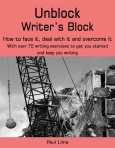
Book Review of Unblock Writer’s Block by Paul Lima

Cover of Paul Lima's Unblock Writer's Block

Click on Cover of Paul Lima’s Unblock Writer’s Block for Paul’s blog and sale places

The desire to write grows with writing.

–          Desiderius Erasmus

In Unblock Writer’s Block: How to face it, deal with it and overcome it, Paul Lima not only debunks some writer’s block myths, but provides some creative exercises to get writers writing. He compares his former writer’s block to “walker’s block,” i.e., not exercising, his situation until his wife got a dog. He started walking daily and the story ideas began arriving – a good thing for a freelancer with 35 plus years of experience writing newspaper articles, corporate, and fiction, who  is the author of 12 books, including the best selling How to Write a Non-fiction book in 60 Days. Lima also writes prolifically and quickly to deadline.

If you are doing other things to avoid writing, Lima says you are procrastinating, not suffering from writer’s block and you need the equivalent of a dog – writing exercises – to get you going on the write track. Lima emphasizes when you write the draft, ditch the editor in your head and just write. He also gives the option of “cherry-picking” exercises to get the most die-hard blocked writer going – a good idea because of the large and varied selection. When reading Unblock Writer’s Block, I kept flipping files to create story ideas. Lima recommends starting with  how you are feeling because you have to have emotion in your writing to connect to your reader. He has exercises for unlocking emotions focusing on the individual and his past, followed by three chapters with activities on freefall writing, directed free-fall writing and clustering – the three parts Lima advises readers do.

Ensuing exercises deal with the actual craft of writing such as plot, characters and point of view in fiction. My favourite exercise is one that could help POV problems. Lima suggests readers write a letter of apology to someone wronged and then switch POV to the other person and have him or her write back and perhaps letters back and forth will follow.

Although Lima uses examples from other authors such as novelists Margaret Atwood and Alistair McLeod (the latter’s cheese story is funny), I would have liked to have seen more Paul Lima stories, although the one where Paul apologized to a telephone pole when he bumped into it (Note: apologizing for everything is a Canadian trait) is priceless. The other bits of humour interspersed add spark to the writing wisdom presented.

Unblock Writer’s Block fulfills Paul Lima’s intentions, i.e.

“Our goal throughout this book is simply to do some writing—to see that we have the ability to write over, around and through whatever may be blocking us. You may not have produced anything you want to continue writing about. You may not have written how you want to write. But that’s not the point. The point is to write no matter what, and to be open to where your work may (or may not) lead you.”

Unblock Writer’s Block is available in paperback and e-copy. To find out where and more about Paul Lima and his books, go to  http://www.paullima.com/books/wb.html.

For Sharon A. Crawford’s upcoming events with Beyond the Tripping Point, go to her Beyond the Tripping Point page– http://www.samcraw.com/Articles/BeyondtheTrippingPoint.html I continually update it.

Today (Thursday, March 28), from 2 p.m. to 3 p.m. I talk about where my characters come from and read from Beyond the Tripping Point at the Leaside Branch of the Toronto Public Library. (See the above BTTP link for more details.)

Cheers.

Sharon A. Crawford


Tags: , , , , , , , , , , , , ,

Getting your book noticed with book reviews

Cover of Sharon A. Crawford's mystery short story collection

Cover of Sharon A. Crawford’s mystery short story collection

There is creative reading as well as creative writing.

–          Ralph Waldo Emerson

Even before your book goes to market you need to stake out possible book review sources. That applies for trade published books, self-published books whether in e-copy, print or both. Often you are ignored but sometimes serendipity steps in and you get a review or two or three, etc.

That happened to me – twice – and from the same event last year. My short story collection Beyond the Tripping Point had a publisher and I had a copy of the contract. But the contract wasn’t signed as I headed into the Bloody Words Conference last June in Toronto. My publisher’s instructions were: get the word out about your book and get some book reviews.

I did it –couldn’t shut up about it even though I felt a little strange doing it all so far in advance of publication. The first reviewer freelanced mystery book reviews for a daily paper from a neighbouring city – Hamilton, Ontario. Before I even got more than my name and I had a book coming out he asked, “So you want a review?” And he took down the particulars. The mini-review came out in print and online December 22, 2012 in The Hamilton Spectator at http://www.thespec.com/feature/article/857834–mini-reviews  (scroll down, it’s the second book reviewed and the newspaper, in error, left out the reviewer’s byline. It’s Don Graves).

The other review is the big serendipity one, thanks to persistence in networking. The book reviewer for Ellery Queen Mystery Magazine – one of the biggies for publishing short stories from mystery authors from around the world (the magazine is published in the United States) was a guest panelist at Bloody Words and also sat at the head table for the banquet. I missed talking to him after his panel gig, but on his way out after the banquet I “accosted” him (read: stopped him, introduced myself and my upcoming book and asked for a review). He gave me his business card and the name of  Jon Breen, the freelancer who does an annual review roundup of anthologies and short story collections. I gave him my card and thanked him. I did have to do a follow-up email to get the email address of the other book reviewer.

Then I emailed the other reviewer my pitch.

And he was interested. So my publisher sent him a pdf. It’s paid off. Recently  my publisher emailed me that he had received the hard copy proofs for that part of the May 2013 issue of Ellery Queen Mystery Magazine. A mini-review by Jon Breen of Beyond the Tripping Point  appears in it. It’s already available online at http://www.themysteryplace.com/eqmm/jury/ Scroll way down – it is there, 12th in the list of books . And it links to http://www.amazon.com

Those two make up for the nonsense trying to get a review in the big Toronto dailies and Quill & Quire, the Canadian publishers’ Bible. The Toronto Star got as far as email communication between me (initiated by me) and back with the reviewer who does mini-reviews of new arrivals. That didn’t happen despite me bringing the book down to her office in person. Some of us authors joked about the supposed big room where the Star stashes all the unreviewed books that come in before disposing of them – and how they do so was pure speculation.

So, what is an author to do to get a review? Besides this combination in-person and pseudo-social media and yes, social media, too, with the latter we can review each others’ books. If like me you have an author profile with your book on amazon.com, Goodreads, etc. this can be done. Just troll the sites to see who’s there. What about other bloggers you follow? You can also at least get interviews about your book on other authors’ blogs. You can do book review trades with other authors – they read and review your book; you do the same for theirs and both of you post your review on whatever social media you can. I’m currently doing this with another very prolific writer, Paul Lima, reading and reviewing his book on Writer’s Block and he’s doing the same with Beyond the Tripping Point. My publisher sent him a Kindle copy of my book and Paul sent me a pdf of his book as that’s what I requested.

So, next week we will revisit Writer’s Block with my review of Paul Lima’s book Unlock Writer’s Block. Paul has some very creative ways to get around this bane of writers.

Then I will have to follow my other advice above – start trolling Goodreads, Linked In groups, etc. to do and get more reviews. And in case anyone is interested in doing and posting a review of my book there or on Amazon.com, let me know. I have Kobo and pdf copies and can get the Kindle one from my publisher. And if you have a book published let me know and I might just review it.Of course, remember the unwritten rule for doing book reviews. The book is free of charge to the reviewer

For my upcoming events with Beyond the Tripping Point, go to my BTTP page on my website – http://www.samcraw.com/Articles/BeyondtheTrippingPoint.html I continually update it.

This evening (March 21, 7 p.m. to 9 p.m.) I moderate an author publisher panel featuring Andrew J. Borkowski,  the 2012 Toronto Book Award winner for his short story collection Copernicus Avenue and his publisher Marc Coté of Cormorant Books. This panel is at a meeting of the Canadian Authors Association Toronto Branch – more details at http://www.canauthorstoronto.org/events.html

Next Thursday, March 28, from 2 p.m. to 3 p.m. I talk about where my characters come from and read from Beyond the Tripping Point  at the Leaside Branch of the Toronto Public Library. (See the above BTTP link for more details.)

Cheers.

Sharon A. Crawford


Tags: , , , , , , , ,

Do your research and get your information correct

Amazon.com link to Sharon A.'s short story collection

Amazon.com link to Sharon A.’s short story collection

Whenever you write, whatever you write, never make the mistake of assuming the audience is any less intelligent than you are.

–           Rod Serling

If you think writing fiction eliminates any research, think again. Especially if you are writing mystery and science fiction. Do you want your police procedure to be incorrect, especially in connection with a crime scene?

According to police, that is a biggie with many authors (TV series are especially bad). Just watch some of the shows. Even a “lay person” can pick out some of the no-nos at a crime scene.

An older version of my short story “For the Love of Wills” from my mystery short collection Beyond the Tripping Point had glaring police procedural errors. I didn’t know that. Then I heard Toronto Police Constable Brent Pilkey, author of the Rage series of police procedural novels  http://www.brentpilkey.com/ talk last June on a couple of panels at the Bloody Words Mystery Writers Conference. One of those panels also featured a Chicago PI turned author. Their topic covered where fiction (mainly TV) gets the crime scene investigation wrong. I thought “oh, oh,” about the “Wills” story and with Brent’s permission, emailed him the first part of the story – just enough so he could see what the heck I was doing. He emailed back with the correct procedure and some suggestions – he was very polite and helpful. He also helped me clarify some skidmark issues in another story “Road Raging” in the same short story collection.

So, he became my police consultant, got acknowledged in my book as well as a complimentary book copy and also has helped me with police procedure for my prequel novel, which is set in the summer of 1998. Some of the procedure and set-up was different then. The one that really grabbed me was how wire-taps were done using reel-to-reel tapes that had to be turned on as the ransom call came in.

That one I should have had an inkling of because of my days as a journalist using reel-to-reel tapes, albeit the smaller cassette versions.

Then there is science fiction. Here, you want to make sure what you are writing about is actually still science fiction and not science fact – even if you take a science fact and spin it out beyond into fiction. A master novelist in that area is the award-winning Rob Sawyer  http://www.sfwriter.com/. Once you have established that you are writing science fiction, you will probably need to do research on how the details would pan out. Even though it is fiction, it has to make sense. The late Isaac Asimov http://www.asimovonline.com/asimov_home_page.html was also a master at that with his Foundation novel series.

You can do research in several ways:

  1. Interview/work with an expert in the area.
  2. Do research on the Internet – Google is a big help (but be careful – check the credentials of the website or blog poster). If you get a good one, you might want to email them for more information.
  3. Read newspaper and magazine articles; also books on the subject. (For my prequel novel, I read a book on serial killers; I didn’t want to rely 100 per cent on Criminal Minds. Also with the novel set in 1998 I didn’t want to mention serial killers and FBI etc. procedure that is post 1998). These three sources can also provide experts for you to contact to obtain further information.
  4. If you are writing historical fiction, or like me, even something 15 years before now, you will need to do a lot more research about what the social economic conditions were at that time. Plus little details – my favourite (although not for my novel) – was canned food available at specific times in history. You would be surprised how far back tinned food goes. You certainly wouldn’t want to have the Countess of Whatever flying around in a plane in 1789, although maybe a hot air balloon as the first one was supposedly invented in 1783 – unless you are writing science fiction.
  5. Time travel can also be tricky as you are bringing a character or character(s) into a past or future time. Besides the obvious of the time-traveller’s reaction to the “primitive” or “futuristic” conditions, you must get the right information into each time period. Diana Gabaldon  http://www.dianagabaldon.com/with her Outlander novel series is an expert at doing this and keeping the reader interested in the story.
  6. And that’s my last point. Don’t bore or bog down your fiction with research. Weave in the research with the story and characters and skip the expository, the character explaining, or worse the author as narrator explaining. It can turn away your reader or at least cause him or her to skip paragraphs, even pages. You know the old adage – it is easier to learn when you are having fun or being entertained.

How do you do research for your fiction?

For my upcoming events with Beyond the Tripping Point, go to my BTTP page on my website – http://www.samcraw.com/Articles/BeyondtheTrippingPoint.html

And clicking on the book logo at the beginning of this post links directly to my entry on amazon.com. Book is available in print and e-copy.

Cheers.

Sharon A. Crawford


Tags: , , , , , , , , , , , , , ,

Putting your social causes into your fiction

Cover of Sharon A. Crawford's mystery short story collection

Cover of Sharon A. Crawford’s mystery short story collection

We care what happens to people only in proportion as we know what people are. — Henry James

Many of the short stories in my collection Beyond the Tripping Point deal with children who get the short end of the stick – missing children, abused children – and trying to save them as well as punishing the perpetrators. For example, in “Unfinished Business,” the protagonist has run away from something terrible that happened to her as a child. When the same evil threatens her daughter, she is forced to do something. Two of the linked stories (“Gone Missing,” “Saving Grace”), featuring fraternal twins Dana Bowman and Bast Overture, and Dana’s seven-year-old son David also focus on finding and saving children. These two stories have an extra kicker as David has been left psychologically mute because of his own bad experience in the prequel novel which I am now working on.

My cause is the safety of children. When I started writing my short stories and the novel I didn’t set out to include this cause. I didn’t realize it was my cause. Many authors have a social cause and they want to get their point across in a short story or novel. The trick is to do so without lecturing or preaching. You don’t want your story bogged down by a character going on ad nauseam about capital punishment, global warming, etc.

How do you get around this?

Make your cause a part of your character and plot. For example, if you are against capital punishment, your protagonist could be a defence lawyer who tries to get the death sentence off the table, or better still, prove the client is innocent. And I don’t mean copying Perry Mason. Or if your cause is justice isn’t there or doesn’t work in the legal system, your protagonist could be a private investigator who goes beyond the law when catching guilty perpetrators. For global warming, your protagonist could be a meteorologist or a geoscientist who has a passion for global warming – for or against.

That’s the characters. Now you have to work them into a plot. The global warming could be a “what if “story, even science fiction (although these days what is happening with weather may kill the science fiction angle – unless you take it to extremes, the world freezing over into snow (already been done in a movie starring Dennis Quaid. Use your imagination. Your protagonist can be the one predicting something like this will happen. Or he or she could be called in by the government to help solve the problem. Or for a twist – he or she could be doing something to escalate or cause the problem (there’s an idea for science fiction).

What runs through stories involving a cause is timeliness. If you set it in the present, your “cause” needs to be something that is going on in the world now. If the cause is something that was dominant in the past, you need to set your stories then. This is something I do with the fraternal twins’ stories and novel. In the novel, part of the plot has to do with something that was big news in the late 1990s, I’m not telling you what, but I will say that it does have to do with children in danger and I also work in other aspects of children in danger, such as kidnappings – something that is unfortunately, always timely.

Another angle for your protagonist and plot is to build in some foreseeing of the future with your protagonist and plot. In the popular Murdock Mysteries TV series, set at the turn of the century (that’s going from the 19th to the 20th century) in Toronto, Ontario, Canada, the protagonist Detective William Murdock, has great respect for the murdered victim (he is a staunch Catholic who makes the sign of the cross when he first sees the dead body). So he is motivated to find the killer and bring him or her to justice. However, Detective Murdock is a far-seeing investigator who uses pioneering methods (some of which he devises, some already just coming into investigating procedures elsewhere) such as fingerprints to help solve the crime

I suggest you read books by authors who do some of the above and watch some TV series, although with the latter, especially, you need to be careful the writers did their research and got it right. But that is a subject for a future post.

Meantime, check out the three parts of an interview I did last fall (links below), just as my short story collection Beyond the Tripping Point (Blue Denim Press, 2012) came out. I talk about my characters, plots and yes, Murdock Mysteries, one of my favourite TV series. Read some of the books by its creator, Maureen Jennings – she has other series’ mysteries published as well and co-developed a story concept which became the Bomb Girls TV series. Check out Maureen Jennings at http://www.maureenjennings.com/

And check out my online TV interview on thatchannel.com posted in three parts on You Tube at:

Sharon A Crawford Beyond the Tripping Interview No. 1 on Liquid Lunch on thatchannel.com.http://www.youtube.com/watch?v=ScuE2g4cWtc&feature=youtu.be

Sharon Reading from Beyond the Tripping Point on Liquid Lunch http://www.youtube.com/watch?v=pgOKYgBfAwY&feature=youtu.be

Sharon A Crawford Beyond the Tripping Interview No. 2 on Liquid Lunch on thatchannel.com http://www.youtube.com/watch?v=5xMhcTRANMY&feature=youtu.be

And don’t forget: clicking on the book cover at the top of this post, links you to Beyond the Tripping Point on www.amazon.com.

Cheers.

Sharon A. Crawford


Tags: , , , , , , , , , ,