RSS

Tag Archives: Marketing your book

Writing conferences help writers

Amazon.com link to Sharon A.'s short story collection

Amazon.com link to Sharon A.’s short story collection

This country’s crazy in terms of fame and what people think it means. They expect a writer to be something between a Hollywood starlet and the village idiot.

– Kent Haruf

Last weekend I attended the Bloody Words mystery writing conference at a hotel in downtown Toronto, Ontario, Canada. It was Bloody Words’ 13th conference since 1999, but it is also their last. Bloody you-know-what. As an author I’ve found Bloody Words to be very helpful, the other authors just as weird (we are crime writers, after all) as me. And friendly and helpful. Two years ago at Bloody Words, I received a lot of encouragement and help for my mystery short story collection Beyond the Tripping Point. And at that time it was accepted for publication by Blue Denim Press but I hadn’t yet signed the contract, although I had a copy and was reading through it. I was also rewriting some of the short stories for the publisher. From this conference, among other things, I found a book reviewer for an Ontario city newspaper, for Ellery Queen Mystery Magazine. and my police consultant, also a mystery novelist (police procedures from the constable’s viewpoint), Brent Pilkey. Brent helped me sort out some police procedure and crime scene difficulties in two of those not-yet-finished short stories.

Fast forward to this year’s conference. My first novel, Beyond Blood, the prequel mystery to four linked stories in Beyond the Tripping Point, is being published this fall by Blue Denim Press. This time the contract is signed and the manuscript final is with the publisher. I also moderated a panel on short stories, Are short stories the new black? which went over well – lots of positive feedback, not only from the panellists but from the audience – there was good rapport among us all during the panel discussion. And I kept us on time – my big bugaboo with running panels. But it helped that for once I didn’t have a panellist who talked too much at a time. Ditto the audience with questions and comments. Great way to share info.

But one of the big pros with this conference is another way to help a writer – in a closer way. One of my editing clients also has his first mystery novel (first published work even) being published by Blue Denim Press in the fall. The editor at Blue Denim Press is calling it Blue Murder and my client, who is also a writing colleague and friend for 18 years,  and I will be doing some publicity under the Blue Murder from Blue Denim Press “banner.” So, I introduced my colleague to many other published authors and we asked questions about PR in different areas of Canada. I introduced him to one of the Crime Writer of Canada executive and she made it her business to get him signed up for CWC – because doing readings with CWC authors at various outlets is good for exposure and we might even sell a few books. I also introduced him to the book critic at Ellery Queen Mystery Magazine who sat at the table next to us during the Saturday evening banquet. He was there with the Hammett (as in the late great mystery author Dashell Hammett – remember The Maltese Falcon?) awards also presented in conjunction with BW. He stated when he needs the books for reviews and in what format. So, he may do book reviews of our books. Also learned a few places to go in Montreal for readings, and I finally joined the Toronto branch of Sisters in Crime who are really good about promoting their author-members’ books and readings.

So all this networking and the panels (I did attend others) were also learning experiences. Among other things I learned that my short stories help other writers with the techniques in their short stories, how other authors create their characters, and had a lot of fun.

More information on Bloody Words is at http://2014.bloodywords.com/

Remember the two mystery novels coming out this October 2014 from Blue Denim Press:

Dead Wrong, a medical mystery set in Boston and Toronto by my friend and colleague Klaus Jakelski who is also a doctor in Sudbury, Ontario, Canada and Beyond Blood, a mystery with the two fraternal twin PIs Dana Bowman and Bast Overture by Sharon A. Crawford. More anon on these as we get closer to the publication date.

And as a follow-up to last week’s posts on writing contests I will be posting a link each week to another writing contest. Here is this week’s, which also has a writers’ and readers’ celebration in Cobourg, Ontario, Canada

Word Northumberland
Saturday, October 25, 10 a.m. to 4 p.m.
The writing contest is just below the celebration deets.
http://spiritofthehills.org/word-northumberland/

Meantime, you can read about my characters and their stories in my short story collection Beyond the Tripping Point (Blue Denim Press, 2012). Click on the book at the top and it takes you to Sharon A. Crawford’s profile – including book reviews – at http://www.amazon.com. The book is available there in print and Kindle. For Kobo e-book go to http://store.kobobooks.com/en-CA/ebook/beyond-the-tripping-point or go to any bricks and mortar store and order in a print copy. Spread the word.
More info on Sharon A.’s upcoming gigs, workshops, guest blog posts, etc. at http://www.samcraw.com/Articles/BeyondtheTrippingPoint.html

Cheers.

Sharon A. Crawford


Tags: , , , , , , , , , , , , , , , ,

What Writers Can Learn from Authors’ Readings

Cover of Sharon A. Crawford's mystery short story collection

Cover of Sharon A. Crawford’s mystery short story collection

I loved words. I love to sing them and speak them and even now, I must admit, I have fallen into the joy of writing them.

          Anne Rice

The emcee introduced me and I headed up to the podium with my book, Beyond the Tripping Point, opened the page to read, looked at the page. And the lighting was dismal – a dim way overhead light. I struggled to see what I was reading. Apparently I did okay – at least the audience heard me or so I was told.

We writers can learn a few things from attending readings by other authors or in my case from my own reading. Here I learned to always carry a printout in 14 pt. to read from in case the lights fail. To date, since then, the lights have been bright enough to read from the book.

A good writer does not necessarily make a good reader. How often have we attended a reading when the author seemed to be in a race against time (understandable as reading time limits can be as little as four minutes), the reading voice was so low we wished they used a mic or the reading was so wooden we dozed off. The latter may be combined with the author reading way too long.

Those are the negatives but they can teach authors how not to read in public.

On the positive side, I’ve learned how to do a book marketing summary, how to pick the interesting bits to read, but the most rewarding is when interaction occurs between the audience and the reader – when the audience starts asking questions about my stories’ plots and characters and when they talk about their stories.

Some of those questions have been a little disconcerting. For example, the driver trainer who asked about the car that lost its brakes in “No Breaks.” He wanted to know if it was a standard or automatic car. Duh. I hadn’t given it any thought. As the story was triggered by a ride to Ontario’s cottage country I had years ago with a friend, I just used the type of car she had – automatic. And yes, what my friend did – used the parking brakes – worked with an automatic car but even I know that there would be problems with a standard car.

But it was a wake-up call to make sure I do all my research even when the proof seems to be in the pudding.

A favourite with many audiences is how much of your stories come from real life and if you can run into trouble with that. I sometimes use a bit from life as incentive for stories and often will bend the “rules” a little. For example, in one story in Beyond the Tripping Point (and I’m not saying which story) I developed an unfriendly character loosely based on someone in my family (not a close relative) who upset me with comments about what should or shouldn’t go in my memoir. But the character wasn’t really her. You could say she inspired the one character. Ditto the nasty father in “Porcelain Doll” whose only connection to my late father was his penchant for being on time and working for the railway. My dad otherwise was entirely different – more gentle, and he certainly didn’t gamble or verbally abuse his wife and daughter. But many of my characters just show up in my head – like the fraternal twins Dana Bowman and Bast Overture – with a mixture of what I see in the world and what I would like to see. As I’ve told other writers – you do have to be careful what you put in, but also be aware that readers sometimes see themselves or people they know in your stories’ plots and characters even when they are not the character source.

And that’s a good thing because it shows you connect with your readers.

So, besides reading your own writing (published or unpublished) in public, why not go to author readings. You might not only enjoy yourself but learn something, too.

Next week I will be expanding my reading experience as I’m adapting my presentation for a grade 7 group at one of the Toronto Public Library branches. And I’m sure I’ll learn something from this younger audience. I will also be reading for adults and moderating a panel of a couple of crime novel authors. Here’s the info on the latter two.

Tuesday, May 14, 7 p.m. to 8.30 p.m.

Crime Writers of Canada Books ‘n’ Beveragesreading with nine other CWC authors at:

Turner Park Branch of the Hamilton Public Library, Hamilton, Ontario, Canada http://www.hpl.ca/events/books-and-beverages-crime-writers-canada

Thursday, May 16, 7 p.m. to 9 p.m.

Crime & Mystery Writing Panel

Moderating a panel of mystery novelists on plot and characters especially when police enter the picture. Presented by the Canadian Authors Association Toronto Branch and featuring Crime Writers of Canada authors, Toronto, Ontario, Canada.

Panelists:

  • Brent Pilkey, author of the Rage novels who, as a police constable with Toronto Police Services, has an inside view of police procedure; and
  • Rick Blechta, whose novels aren’t exactly cozies — all have main characters involved in the music industry and when murder enters their lives, come into contact with the police.

More info http://www.canauthorstoronto.org/events.html

Check out more May readings, etc. at http://www.samcraw.com/Articles/BeyondtheTrippingPoint.html

Cheers.

Sharon A. Crawford
 

Tags: , , , , , , , , ,

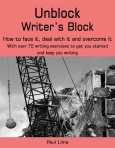
Book Review of Unblock Writer’s Block by Paul Lima

Cover of Paul Lima's Unblock Writer's Block

Click on Cover of Paul Lima’s Unblock Writer’s Block for Paul’s blog and sale places

The desire to write grows with writing.

–          Desiderius Erasmus

In Unblock Writer’s Block: How to face it, deal with it and overcome it, Paul Lima not only debunks some writer’s block myths, but provides some creative exercises to get writers writing. He compares his former writer’s block to “walker’s block,” i.e., not exercising, his situation until his wife got a dog. He started walking daily and the story ideas began arriving – a good thing for a freelancer with 35 plus years of experience writing newspaper articles, corporate, and fiction, who  is the author of 12 books, including the best selling How to Write a Non-fiction book in 60 Days. Lima also writes prolifically and quickly to deadline.

If you are doing other things to avoid writing, Lima says you are procrastinating, not suffering from writer’s block and you need the equivalent of a dog – writing exercises – to get you going on the write track. Lima emphasizes when you write the draft, ditch the editor in your head and just write. He also gives the option of “cherry-picking” exercises to get the most die-hard blocked writer going – a good idea because of the large and varied selection. When reading Unblock Writer’s Block, I kept flipping files to create story ideas. Lima recommends starting with  how you are feeling because you have to have emotion in your writing to connect to your reader. He has exercises for unlocking emotions focusing on the individual and his past, followed by three chapters with activities on freefall writing, directed free-fall writing and clustering – the three parts Lima advises readers do.

Ensuing exercises deal with the actual craft of writing such as plot, characters and point of view in fiction. My favourite exercise is one that could help POV problems. Lima suggests readers write a letter of apology to someone wronged and then switch POV to the other person and have him or her write back and perhaps letters back and forth will follow.

Although Lima uses examples from other authors such as novelists Margaret Atwood and Alistair McLeod (the latter’s cheese story is funny), I would have liked to have seen more Paul Lima stories, although the one where Paul apologized to a telephone pole when he bumped into it (Note: apologizing for everything is a Canadian trait) is priceless. The other bits of humour interspersed add spark to the writing wisdom presented.

Unblock Writer’s Block fulfills Paul Lima’s intentions, i.e.

“Our goal throughout this book is simply to do some writing—to see that we have the ability to write over, around and through whatever may be blocking us. You may not have produced anything you want to continue writing about. You may not have written how you want to write. But that’s not the point. The point is to write no matter what, and to be open to where your work may (or may not) lead you.”

Unblock Writer’s Block is available in paperback and e-copy. To find out where and more about Paul Lima and his books, go to  http://www.paullima.com/books/wb.html.

For Sharon A. Crawford’s upcoming events with Beyond the Tripping Point, go to her Beyond the Tripping Point page– http://www.samcraw.com/Articles/BeyondtheTrippingPoint.html I continually update it.

Today (Thursday, March 28), from 2 p.m. to 3 p.m. I talk about where my characters come from and read from Beyond the Tripping Point at the Leaside Branch of the Toronto Public Library. (See the above BTTP link for more details.)

Cheers.

Sharon A. Crawford


Tags: , , , , , , , , , , , , ,

Lessons learned from the actual book launch

Sharon A. Crawford reads at the book launch of Beyond the Tripping Point

Put it before them briefly so they will read it, clearly so they will appreciate it, picturesquely so they will remember it, and above all, accurately so they will be guided by its light.

~ Joseph Pulitzer

The book launch for my debut short story collection Beyond the Tripping Point has happened.and I’m still going around in overwhelm. First off it went well – we filled the backroom of The Rivoli and everyone had a good time. The Rivoli want my publisher and his authors and the entertainment (Sunny and Shane) back next year. So, my publisher is happy.

But I learned a few things from the experience and I’m passing them along for anyone out there organizing and experiencing their first book launch. Some of the points also are pertinent for doing public reading.

First I’d like to state that I was in a state of shock and operated on automatic pilot throughout the three hours. Not from nervousness, not from the time change overnight to eastern standard time, and not even my always time-strapped life. It was a phone call from a friend earlier that morning. And if you want to find out about that you will have to read my other blog’s post this week at http://www.onlychildwrites.wordpress.com

Now on to lessons learned.

When you are on stage at a club or pub, the lights may be too good – you can see what you are reading but you can’t see beyond the lights into the audience. You have a bright-light blockage. I like to connect to my audience when I read.

The next day (and thank you Shane for waiting until the next day) the editor at my publisher’s said I had read too long with the second and last reading. For one story, I had attempted to combine reading story excerpts with filling in a few storyline gaps. My editor said he saw a few people fidgeting. (I blame this one on being in shock/autopilot as I did the practice for this at home after the phone call). However, I am taking my editor’s advice for next readings. So time yourself to the second when you practice and when onstage reading, check your watch at the beginning and glance at it a few minutes later.

Mingle more with your guests. I did a lot of mingling, going around to tables chatting with my guests during the first part of the meet and greet and signing books. Then I sat down with my son and his girlfriend to talk to them. But I invited some friends to the table and also got up a few times to talk to others. I stayed put after that, except to go onstage to read. My police consultant came up to the table just before the music started so we didn’t have time to say much. I can’t carry on a conversation over performances on stage and don’t like to talk when authors are reading. After all the readings, friends and colleagues came up to say “hello” and for me to sign their copy of my book. But I wished I could have talked to them all more. I didn’t even see my cousins from out of town until afterwards – I joined them then. My son said that now I know how it is with him when one of his bands has a CD launch. I know that people do come in late and have to leave early and that can’t be helped. One of my friends later told me she would have liked a longer mingling session.

And connected to my other blog’s post – don’t try to arrange transportation, including car pools, for anyone coming to the launch. Just give them the location and directions there.

It also helps if you get enough sleep, which I hadn’t and still haven’t lately.

Besides the photo at the top, you can go to  http://www.flickr.com/photos/writershane/sets/72157631935084560/ In the audience photo, the fellow who looks like he is napping is my son. I’m not there because I’m on stage.

And if you click on my book photo below, it takes you to Amazon.

Next week back to more of the ins and outs of writing fiction with brief information about my upcoming readings, etc.

Cheers.

Sharon A. Crawford

Cover of Beyond the Tripping Point


Tags: , , , , , , , ,

Getting published the traditional trade book way

Book cover for Beyond the Tripping Point

Times are bad. Children no longer obey their parents, and everyone is writing a book.

— Cicero

I’m off to another public reading for my just released collection of mystery short stories Beyond the Tripping Point (Blue Denim Press, 2012). It’s all part of the book promo and it is and has been busy, what with trying to get book reviews, nailing TV and radio appearances, etc. My publisher shares this marketing, which really helps.

But before you get into this book PR, you have to land your publisher or literary agent. And that can seem daunting. There are so many unpublished authors with talent, many more than “publishing spaces.” E-books are creating more readers (and more publishing space), but some authors are going the self-publishing route and I say more power to them. But what about those who prefer the traditional route?

You can’t just dump your novel or short story collection on an agent or publisher. They don’t have time to read the whole story unless something about it grabs their attention. Your job is to get their attention – right away.

One way is through query letters, synopses, and sample chapters. Some agents and publishers want this whole package; most prefer the query letter only and then if that gets their attention, they will ask for more.

A good query letter has to hook the agent or publisher with the first sentence. Starting with the obvious “I’m looking for an agent to represent my novel” will put the agent to sleep. Grab the agent with a wowee sentence about your book. Here’s an example. “When Abigail Cooke reunites with her birth mother, she has no idea that her new family connection will lead to buried bodies, psychosis, and the Mob.”

There are variations to the “when setup,” which focus more on the characters, the time period – whatever is most pertinent to your novel AND will grab the agent’s or publisher’s attention.

In your second paragraph you get to expand – a little. In this mini-synopsis you give the highlights of your novel’s plot and main characters. Pick the attention getters. Don’t do it resume style – it has to flow – and watch for boring summaries starting with “Abigail Cooke is a tall, slim blonde who teaches kindergarten.” Yawn. What does that have to do with your beginning sentence? The agent or publisher wants to read on from paragraph one. It also is a good idea to give the title of your book. Better would be “In Can of Worms, Abigail Cooke, a young schoolteacher who was adopted at birth, has always found something missing in her life – her birth mother. After agonizing the pros and cons, she starts searching online and finds her birth mother, Sara Tusani. The two begin an email correspondence. Despite Abigail’s apprehension about Sara, which she puts down to “just nerves,” she agrees to meet Sara in her native Rome, Italy during her summer vacation. When she’s met at Leonardo da Vinci Airport by her mother’s chauffeur, but not her mother, she ignores her gut feeling of apprehension and relishes the luxury. When she arrives at Sara’s mansion on the outskirts of Rome and meets her mother’s brother-in-law, Luigi Tusani, a philandering alcoholic and her half-brother, Giuseppe Tusani, a computer nerd who hibernates in the attic, she has second thoughts. But her mother seems normal, gracious and friendly…at first. As the day turns to dark, loud bangs and a haunting caterwauling in the mansion wake up Abigail. The next morning’s questions give her only “you must be imagining things” answers. That night when the noises come, Abigail is ready. Grabbing a hairbrush for a weapon, she leaves her room, walks along the hall and goes downstairs into the kitchen, sees the basement door open, and takes the stairs down…”

You would add a sentence or two, supplying a bit more information. Depending on your storyline you can have a summary sentence that perhaps goes back to your first paragraph’s sentence, for example, “Abigail finally realizes she should have listened to her instincts and now must lose her new family or risk losing her life.”

Paragraph three covers your background – published writing (books, stories in journals or magazines, newsletters, especially if you’ve won any writing contests or awards). Not a published author? What about your education and expertise? Is it related to your novel? For example, for Can of Worms if the author is adopted and tried to find her birth mother, is or was a school teacher, and has travelled to Rome (in order of importance to the novel – all not necessary), you can use that to establish credentials for writing the novel.

Some agents or publishers want a little marketing information from you, so you could either put it in a second sentence in paragraph one or write a short fourth paragraph (better). Focus on how your novel is different from what’s out there. Be specific, including naming another novel. Also state who your readers would be (thirty-somethings, seniors, adoptees, etc.).

Your final paragraph is The Thank You and the Ask. Thank the agent or publisher for their time, ask if they would like a synopsis and sample chapters and you look forward to their reply.

Your query should be only one page but with most sent by email you can cheat – but just a little – no equivalent to one and a half to three pagers. Another suggestion: check submission guidelines on the agent’s or publisher’s website and follow them to the well, query letter.

For those of you in the Toronto, Ontario, Canada area, Brian Henry is running a workshop on Getting Published which includes writing a query letter and a literary agent as guest speaker. This workshop is sponsored by my East End Writers’ Group and will be held at The World’s Biggest Bookstore in downtown Toronto from 10 a.m. to 4 p.m. Saturday, October 13, 2012. Check for more details and how to register at http://quick-brown-fox-canada.blogspot.ca/2012/06/how-to-get-published-workshop-toronto.html

Next week we’ll go into another way of getting the attention of agents and publishers, including how I got my publisher for Beyond the Tripping Point.

Cheers.

Sharon A. Crawford


Tags: , , , , , , , , , ,