RSS

Tag Archives: writing

Using Fiction Tools to Write Memoir (continued)

Again, I connect you to my post on my Only Child Writes blog. This time it is using another fiction writing technique for memoir – setting. Blog post is here.

And next week we’ll get back to strictly fiction.

Cheers.

Sharon A. Crawford

Author of the Beyond mystery series.


Tags: , , , , , , ,

Memoir writing and fiction writing are connected

Writing fiction and writing memoirs have a few things in common. Both have characters; a POV, setting, narrative and dialogue. But there is something very different about them, that you need to remember. In fiction, you make up your plot and characters. In memoir you are telling your truth, your life (or parts of it as you remember). And the people in a memoir are real people from your past and/or present – even if you change the name to protect the guilty. However, in both fiction and memoir, emotions and feelings are very important.

As mentioned in last week’s post, I am teaching a memoir writing course at the Toronto Reference Library. And again like last week I put a snippet of what we cover this week on my other blog Only Child Writes. Like last week I’ll refer to it and this time will include the link here.

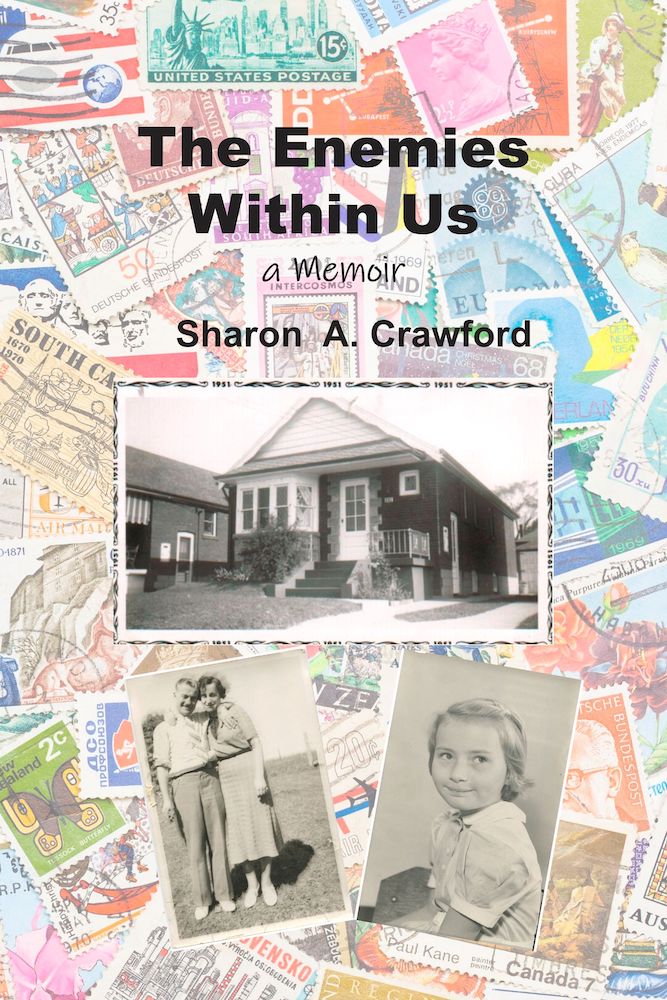
In this post I excerpt a small part of a chapter from my memoir. The excerpt is shortened even more. And yes, I change the people’s names. But the excerpt shows how you can write memoir, fiction style. The main character here is of course, me (or in your memoir, you).

Cheers.

Sharon A. Crawford

Author of the Beyond mystery series. More info about  Beyond Blood here.


Tags: , , , , , ,

Sharon writes M and M

I like to say I write “M and M.” And I don’t mean the candy – although I am a chocoholic. What I write is mystery and memoir. And because I’m one day late with this week’s posting  (too many deadlines, don’t ask), I want to take a look at the second M – memoir writing. Or in my case this month teaching memoir writing  – four weekly sessions at the Toronto Reference Library.

Before I go off on a memoir tangent, I want to mention that many authors, besides me, who started out writing and in some cases, publishing memoir books, also turned to fiction. For example, Catherine Gildner of the Too Close to the Falls memoir “series” – three books so far, also wrote the mystery Seduction. Ross Pennie,whose first published book was a memoir of his time as a young doctor in now writes the Dr. Zol Szabo medical mystery series. If you go to to the Crime Writers of Canada website and check the members biographies, you might find a few more who write M and M. And their quarterly e-publication Cool Canadian Crime (it’s free and available to all, not just CWC members) keeps mystery readers (and writers) up to date on members new books.

So back to that Memoir Writing Course and the connection here I am going to make. I also write another weekly blog on Tuesdays – which focuses on growing up an only child and the consequences over the years since. That gives me leeway for many topics, including writing memoir and teaching memoir. On this other blog, called Only Child Writes (what else would I call it?) for the Tuesdays this month I have been posting a snippet post and a link to it to read the rest. It is all writing and some of it can apply to fiction writing as memoir, although the truth according to the author, is written in fiction style.

Only Child on Research for your Memoir

“Have you found Grandpa’s farm?” my cousin Leona asked me when I called her just after arriving in Walkerton, Ontario.”

This is all part of my research for my family history on my mother’s side.

Read on. Can you see possibilities in what happened for some short fiction?

Cheers.

Sharon A. Crawford

Author of the Beyond mystery series. More info about  Beyond Blood here.


.


Leave a comment

Posted by on April 14, 2017 in Blogging, Writing


Tags: , , , , ,

Let it rain – between your book covers

I hate heavy rain, especially large amounts, especially mixed with strong winds. Which we are getting today in Toronto,Canada. So, what am I doing about it? Besides staying in and checking the basement for any water getting in?

I put the rain in my third Beyond mystery book. Not the rain coming down right now. In one scene I have my main character, PI Dana Bowman, walking through a rain – heavy with blowing winds. Unlike me, Dana drives, but she has been somewhere near home so left the car in the driveway before the rain started. Now she is walking home, but the rain and what it brings – including the kickstart to the novel’s story- begin happening as she struggles through the rain.

In a nutshell, I took a re-occurring scenario in my life, a scenario I don’t like – and fictionalized it.

You can do that, too, but there are caveats.

  1. If your story occurs in another time – an that means not today – make sure you are accurate in presenting your story.. My novel takes place in late fall 1999 in a fictional town called Thurston, Ontario. Thurston is loosely based on Aurora and Newmarket in York Region, Aurora is where I lived for 23 years – although I got out of Dodge in 1998. Rain storms today are not the rain storms of 1999. In Canada and the United States we get way too many and in some cases they are of possible flood proportions. The winds now are stronger and more frequent. So I researched Environment Canada’s historical weather information for the lower half of York Region in  November 1999, right down to the day.
  2. You may think your memory of your situation is clear in your mind to the point where you are right there, but it might be a good idea to list its components – with the rain again – were there many puddles?   Did the wind turn your umbrella inside out? Was it daylight, dusk or night? What exactly from this scene do you want to use – its essence or something specific?
  3. Remember, the scene must have something to do with you story’s plot. Don’t just put in heavy rainstorms because you like or hate them and find them cool. Maybe your main character is chasing someone in the rain. Does he or she slip or fall? What is going on around her? I work in the cars splashing by and what Main Street, Thurston is like during a rain storm. But it is all part of the plot.
  4. When you get down to actually writing that scene in your story, keep writing and don’t stop. Hopefully you’ve done any research and have some idea how you want to morph it into part of your story. When you go through it to rewrite, you can check to see if it makes sense, if it is part of the plot.
  5. Make sure it doesn’t go off into a long expository tangent.Just work in some information with your plot.For example with the rain in my novel, I show the reader how heavy the rain is by how it affects Dana struggling to walk along Main Street and also the others she meets, including … well, that would be giving some of the plot away,

And don’t forget to enjoy, to get lost in the creativity of the writing. It can help get your mind off current problems – even if they include heavy rain. Speaking of which, it is time to check the basement again. And oh yeah, it was also our garbage pickup day today, so while we had a lull in the rain earlier, but not the heavy wind, I was continually running outside to right bins – mine and a few friends across the street. And of course, today was the day the city decided our street should have the new supposedly racoon-proof green bins for wet waste delivered. They may be racoon proof, but not extreme-weather proof. The bins were flying all over the place and mine came minus the scoop and instructions. I did grab the instruction paper as the wind blew it down the street. A very wet sheet, now drying on a kitchen chair.

But that’s for another story, another day. Dana Bowman wasn’t dealing with garbage bins.

How do you work reality into your fiction?

And as usual, click on the Beyond book icon at the top to find out more about the first two Beyond books.

Cheers.

Sharon A.. Crawford

Dana Bowman, looking for her umbrella before braving the elements?


Tags: , , , , , , , , ,

Rolling out the author readings with Canadian Authors Toronto

Now that spring is here, it is time for me to get back into author readings.So next Tuesday evening, April 4, I will be taking my Beyond books for a reading at a Toronto library branch. Four other authors will join me: Bianca Lakoseljac, K.V. Skene, Michael Pawlowski, Ellen Michelson, Catharine Fitton

The readings are being held by the Canadian Authors Association Toronto Branch. This branch has been shall we say “sleeping” the past couple of years, but now branch president Chris Canniff has kick-started it with this author reading which is open to the public.

The Canadian Authors Association has been around for close to 100 years. It was started in 1921 by some prominent Canadian authors, including Canadian humorist, Stephen Leacock. It’s focus has been and still is “writers helping writers”, which it does in many ways. These include work with copyright issues for writers, establishing literary awards including the annual CAA Literary Awards for non fiction, fiction, poetry, and drama. CAA also came up with the first book contract between authors and publishers.

And, oh yeah, members are both published and non-published authors.CAA has branches right across Canada.

Some of these branches have a Writer in Residence. Vancouver branch’s WiR is well-known poet, editor, and short fiction author Bernice Lever. Bernice used to live in my neck of the woods and she was one of my mentors. She used to run a writing critique group in Richmond Hill, just north of Toronto. When I lived in the area, I attended it. Bernice inspired me to start my East End Writers’ Critique group in September 2000 and EEWG is loosely based on the Richmond Hill group.

I, too, had the honour of being Writer in Residence for the CAA – the Toronto branch, from 2001 to 2003, and then again from 2009 to 2015, although the current Toronto branch website still has me listed as WiR. The website is to be updated shortly.

You can check out more about the Canadian Authors Association here. There are links to the branches and much more information.

As for the Toronto branches Authors Reading evening, here is the “dirt” according to Chris Canniff and a link to the CAA Toronto Facebook page. And you don’t have to be a CAA member to read at this event, but if you are in the area you can drop in to meet us.

“We want your stories! The Canadian Authors Association Toronto Branch is having a meeting on Tuesday, April 4 at 6:15pm and we want you to come prepared to read, or come to listen to what others are writing. Event details are below Bring your best work, or a work in progress! Please RSVP to president@canauthorstoronto.org to sign up for a reading. Readings are generally 3-5 minutes long, but that can be extended depending upon the number of readers. Beverley Burgess Bell, who hosts an Oakville Writers Group, will be moderating. Come out, bring a friend, and help us make this meeting a success. We look forward to seeing you there! Check out our new Facebook page, at > https://www.facebook.com/CanadianAuthorsAssociationTorontoBranch/ And our soon-to-be-updated website www.canauthorstoronto.org Event Details: What: Member Reading. Non-Members are also welcome to attendd, but all members and non-members should RSVP. Non-members are encouraged to consider membership!
When: Tuesday, April 4 from 6:15 – 8:15 Where: Toronto Public Library [Annette St. Branch] – 145 Annette St. Website: http://www.torontopubliclibrary.ca/detail.jsp?R=LIB022 Location Details: Closest major intersection is Keele and Annette Streets. Branch is located on the southwest corner of Annette Street and Medland Street.”

And if you click on the Beyond book icon at the top it will take you to more info about my books.

Cheers.

Sharon A. Crawford


Tags: , , , , , , , , , , ,

Listen to your publisher

I am lucky that the editor at my publisher’s goes through my submitted manuscript and makes suggestions. Then we book a phone consult to hash through all these suggestions and comments.

It really gets me thinking beyond whatever box I was writing in.

I had that experience earlier this week. This was the “final” submission, i.e., the one that would make or break whether my new Beyond novel would be accepted for publication.He was quick to praise that it was a much better story and worth being published, but it came with the suggested changes. And some of them pointed out what wasn’t working and left the how-to-do-so up to me.

So we had, as the current dialogue goes, “a conversation about it”. We were both polite but explored what could be done. He said he had read the novel as a reader and not a publisher and that’s where his suggestions came from.

Besides stretching the creativity limit, it also served as pointing-out what just might not work. He didn’t say it, but he was playing devil’s advocate.

Not all publishers do this with their authors – whether new. Often it is “my way or the highway if you want it to be published.” That often stifles the author’s creativity. It is okay for authors to talk about why they wrote what, but go from there. Get past the ego that everything in your manuscript, down to the last comma, is sealed in gold and it has to be published exactly that way. We have probably all read published trade books where the publisher gave the author (often a well-known author) free rein. I won’t mention any names, but some of those books could have been shortened by 200 pages or so.

Getting published, at least by a trade publisher, is a two-way street. Remember, your publisher wants to sell your book, so making that more viable is a good idea. And it can also increase not only your royalties but the book’s presence in a very crowded market.

I have to the end of April to make the changes. So, after our phone conversation, I spent the rest of the afternoon and into dinner time going through the whole novel again and making short comments to his comments based on our conversation. Because being human, I would not remember it all if I didn’t do that.

I’ll keep you posted on Beyond Faith.

Meantime, you can familiarize yourself with the Beyond mystery series by clicking on the Beyond Blood icon a the top.

Cheers.

Sharon A. Crawford


Tags: , , , , , , , ,

Three Author Snafus Editors find

I’m wearing my Editor’s hat today and the hat pin is keeping it firmly in place. There are several “concerns” (to put it gently) I come across when editing an author’s fiction manuscript. Today, I’ll highlight three of them with quick suggestions on how to avoid.

  1. Point of View does the lice movement, i.e., switches heads a lot. Sometimes this switch occurs many times within one scene and it is confusing for the reader. The scary part here is some of the POV switching occurs in published novels. Somebody was dozing at the wheel. Yes, you can have multiple points of view in a novel. Often, depending on the novel’s plot, multiple POV is very necessary. But the rule of thumb is to keep the same POV for the chapter, or a scene in the chapter. Get inside one character at a time. If it helps subhead the POV character’s name for the chapter or scene (you can remove that subhead later). Refer back to that subhead when you finish writing the scene’ or chapter’s draft.
  2. When detail becomes expository. This can happen with describing rooms, towns or history and when it gets out of hand can put the reader to sleep. Why? Because the prose is coming across as a lecture. Even putting it as dialogue doesn’t always help. Yes, put the character in the scene and if describing rooms or towns, beaches, etc. do it as the character goes into the room, etc. and what they see. If the room is untidy, maybe they trip over something. For history, keep it to a minimum – what actually is connected to the story’s plot – not the area’s whole history from BC. Yes, use some dialogue, but keep it short and have the characters do something while talking, have other characters ask the history teller questions or make comments. And have the conversation interrupted with something else happening. For example, if they are in a car, maybe the car blows a tire; maybe they are being followed (but watch the POV here); and maybe there is a sudden storm.
  3. Weird formatting in Word. I’m talking beyond what a copy editor would do – such as changing paragraphing to traditional style for submission to publisher. I have had hard returns in manuscripts, extra space suddenly appearing at the bottom of the pages, backward quotation marks. And my favourite for “the author is in the doghouse” – submitting a manuscript for editing when the manuscript has already been formatted in Word’s book form. Huh? Keep it simple and basic. If you can’t do this, hire a Word professional to type up your manuscript. Oh yeah, handwritten manuscripts are never acceptable.

These are just a few of the “idiosyncrasies” I have received from authors expecting me to edit their manuscript.and I have received worse.

Okay, back to wearing my author’s hat.

And as usual, if you click on the Beyond book at the top, it will link to more information. Teaser: there may be some news of another Beyond book soon.

Cheers.

Sharon


Tags: , , , , , , , , ,

Writing fiction from reality

beyond-the-tripping-point-cover Amazon link-72dpi4Sometimes writing fiction from reality can make a stronger story. And I am not referring to the “reality” of so-called reality TV shows. I’m talking about your personal experiences.

There is a catch, though. You are writing fiction so you need to change charactes’ names. You might also want to change places and timelines. One of the most important points is that because this is fiction, you can change what happens – in fact you can use what happened in your life as the seed for your story and go from there.

One of the short stories, Porcelain Doll, in my short story collection Beyond the Tripping Point (Blue Denim Press, 2012) is taken from a regular occurrence in my childhood – but a pleasant one. So I did a “what if?”

My late father worked for many years as a timekeeper for one of the railway companies. Mom and I had free travel passes on that railway line and the competing railway. That was how we travelled to visit Mom’s relatives and to other places each summer.

So, I took that travel and the approximate time and created a “What if?”

What if the dad was a bully?( My Dad wasn’t.) and the mom was a doormat scared of him? (My Mom wasn’t.) What if the dad also bullied the daughter? (My dad didn’t – he used to call me his princess.)

So, I extracted a few facts from real life – a family of three who annually visited a grandfather on a farm, the mom knitting, the dad obsessed with the train service, and what the train ride was like at that time (early to mid-1960s), and the daughter’s obsession with reading Agatha Christie mysteries and dolls. Here the resemblance gets more than murky.

What never happened on a train in real life (at least not on any trips I took), occurred here – from playing poker for money, a prize doll (hence the story’s title), murder, disappearances, the aforementioned bullying – and the aftermaths. Story is told going back and forth between the present (1989) and the past to move the plot along to a startling conclusion.

With this use of my past I could get the feeling of being there on a train ride in the late 50s and early 60s including some little known facts such as the trains actually had a separate coach for smokers and you couldn’t smoke in any other coach, a somewhat novel idea in the days before smoking and non-smoking regulations across the board. My dad smoked back then. There was also the train route and where you would have to change trains – although I kept it to the same route I changed the location where the grandfather lived. So, I had feelings and remembrances of these train rides.

What I didn’t have was how the little girl in Porcelain Doll would react and act to what happened. That was pure fiction and that is where I had to get inside Sarah’s head. And…

No, I’m not telling you anymore. This is an example to give you an idea how you can do it. If you are stuck for a story idea. I think Porcelain Doll is a stronger story because of my past experience. Certainly others who have read it have said so.

If you want to read Porcelain Doll and the 12 other stories in Beyond the Tripping Point, you can click on the book icon at the top to get more information about the book.

What personal experiences have you had that could be turned into fiction – with a lot of well, fiction in them?

Cheers.

Sharon A. Crawford


Tags: , , , , , ,

Same old same old to twisted plots

beyond-the-tripping-point-cover Amazon link-72dpi4If I saw one more TV mystery where the cops found the dead body in the trunk, I was going to do more than scream. And I did. I wrote “The Body in the Trunk” (from my short story collection Beyond the Tripping Point, Blue Denim Press, 2012). Instead of a body being found in the trunk the story deals with getting a body into a trunk and the why behind it. I also, as I often do with these stories, wrote it as a satire, in the noir black vein.

At one point I was also getting bored with reading mystery novels where the main character, a private investigator seemed to be continually broke. So, in “The Couch” I created a young (mid-20s)  private investigator who has too many clients. The story, also a satire noir black, deals with how the PI tries to downsize the clients – first using standard legit means, and when that doesn’t work, turning to crime. The payback is unexpected. “The Couch” was first published in an anthology, before being published in Beyond the Tripping Point.

So if you hit writer’s block on creating a new plot – take a twist on an old one, but one that is overused to the point of boredom.

And let your creativity loose.

You never know what will surface. It is just criminal. (Sorry, couldn’t resist that).

Cheers.

Sharon

And as usual, click on the book icon at the top to find out more about my Beyond books.


Tags: , , , , , , , ,

Snafus getting in the way of your writing?

The latest Beyond book in the series

The latest Beyond book in the series

The actual “final” rewrite of my latest Beyond mystery is coming along and I am enjoying doing it because I get more creative insights, can fix inconsistencies, check the research and am really tightening up the wordage.

However, I’ve hit a few outside snags that are interfering with my writing time. And they make me angry. So, I’m doing something about them.

One biggie comes under the heading “My health ate my life.” So far since 2017 arrived I’ve been and am faced with two separate unexpected molar extractions. The dental surgery for the second is the day before my publisher’s deadline. As he has given me two extensions already and for health reasons, I do not want to push my luck – it would also not be fair to the publisher.

To get the manuscript and its synopsis (the latter rewritten this week with the word count part left open so far) done in time, I’ve arbitrarily given me an earlier deadline before the publisher’s and before the dental surgery.

It has also forced me to do something I had started to do this  year. Get rid of a lot of the stuff I do that isn’t really important and put some of the others in “pending”.

So far I’ve cancelled me going to a meeting tonight, limited what I get involved in within my community. Important are my East End Writers’ Group and keeping track of a nearby Light Rail Transit line being built as that will affect me in many ways. I am also a member of a local garden club and go to some of their meetings but no volunteering there this year. A couple of other community things I’m interested in I signed petitions and will let the persons organizing them do all the work – just keep me informed. At this point I am also careful of how many social and pseud-social events I go to.

And I finally found someone to shovel my snow when we get bigger snowfalls.

The big take-away point here for writers – whatever you are writing or rewriting – is you can’t do everything, especially what others think you should be doing. Figure out what is important and don’t be afraid to say “no” and/or put some of that on hold. Prioritize. Make the word “no” a big word in your vocabulary even if you have to post it all around your house and on your devices – maybe create an electronic file with a big “NO” and click on it sporadically. You can figure something out.

What I have kept in is family. Last Saturday I was to take out my son and his girlfriend for his birthday dinner (which is actually tomorrow but he will be out of town in the US for a tour with his band – Beams). Martin was sick last weekend. I wanted to see him and at least get his birthday present to him before tomorrow – the present, although not connected to music, is something useful for travelling. So, we arranged for me to make a “flying visit” to his and his girlfriend’s place in another part of Toronto last evening – if you can call buses and subway “flying.” He was feeling better. Dinner will be rescheduled when he returns home.

I know this isn’t exactly about writing, but perhaps if those getting distracted from their writing from whatever, can see one person’s way to deal with the problem, maybe it will help.

How do you deal with writing distractions?

Comments please in the comment section.

Cheers.

Sharon

And as usual, click on the book icon at the top to find out more about my Beyond books.


Tags: , , , , , , , , ,