RSS

Category Archives: Sharon A. Crawford

Same old same old to twisted plots

beyond-the-tripping-point-cover Amazon link-72dpi4If I saw one more TV mystery where the cops found the dead body in the trunk, I was going to do more than scream. And I did. I wrote “The Body in the Trunk” (from my short story collection Beyond the Tripping Point, Blue Denim Press, 2012). Instead of a body being found in the trunk the story deals with getting a body into a trunk and the why behind it. I also, as I often do with these stories, wrote it as a satire, in the noir black vein.

At one point I was also getting bored with reading mystery novels where the main character, a private investigator seemed to be continually broke. So, in “The Couch” I created a young (mid-20s)  private investigator who has too many clients. The story, also a satire noir black, deals with how the PI tries to downsize the clients – first using standard legit means, and when that doesn’t work, turning to crime. The payback is unexpected. “The Couch” was first published in an anthology, before being published in Beyond the Tripping Point.

So if you hit writer’s block on creating a new plot – take a twist on an old one, but one that is overused to the point of boredom.

And let your creativity loose.

You never know what will surface. It is just criminal. (Sorry, couldn’t resist that).

Cheers.

Sharon

And as usual, click on the book icon at the top to find out more about my Beyond books.


Tags: , , , , , , , ,

Creating suspense in fiction

The latest Beyond book in the series

The latest Beyond book in the series

How many books have you read where the plot seems to flatline? Maybe the characters get too chatty. Maybe the description of characters or setting reads more like an expository. Maybe the scenes themselves are mundane. Do you then yawn?

Those spell boredom for the readers. And I see it happening in novels that are supposed to be mysteries. A village scene, instead of creating some touch of menace or at least some suspense, reads more like a slice of village life. Not all authors can do the village scene as well as the late Agatha Christie did.

There are ways your novel can get a life readers will want to read about. And just to clarify. Suspense doesn’t only equal mysteries and thrillers. All fiction needs some suspense – and that includes romance novels with their relationships. In fact, the twists and turns of relationships in any novel are fodder for creating suspense. Characters are at the core.

Here a few tips to create suspense in fiction:

  1. Start your story with something to draw in your reader. If you must have your village scene, get inside your main character’s head and show her take on the scene. Perhaps she dreads the town council meeting, the gardening club meeting, the tea, etc. Why? Or something terrible happens at the beginning at that meeting. Here’s a quick example. Marion would never call Fairfax council meetings boring again.
  2. Dialogue is good – reveals and develops characters and their interactions, as well as moves the plot forward. Unless your characters get overly chatty and go on and on for pages about religion, politics and more mundane things. All three might be relevant to your story, but add some spice, some suspense. Maybe one of the characters chatting is not making sense, seems to be high on something. More to the point, have a character reveal something startling to move the plot forward. Or have the dialogue interrupted by something happening. Depending on your story’s genre, could be somebody unexpected bursting into the room and creating chaos.
  3. Character descriptions. Forget the long expository but blend it in with the storyline and reveal something or several somethings about the POV character and other characters in this scene. In Beyond Blood, PI Dana Bowman meets Det. Sgt. Donald Fielding for the first time when her house is broken into. I show it from Dana seeing Fielding from the feet up as he comes down the basement stairs. The two clash. Dialogue and action show this and builds suspense about what could happen later on with two strong personalities trying to solve crimes when they can’t even agree on what crime happened in Dana’s basement. You can also have characters make snide remarks about another character’s hair or clothes. That would tell you something about both characters. Some narrative is necessary, but don’t drone on.
  4. Same can be said for settings. Nothing is more boring than reading paragraph after paragraph describing the main street of a town or the town itself. You aren’t writing a travel piece: you’re writing a novel or short story. In my Beyond mystery novels, I don’t just describe the town of Thurston, Ontario (fictional town), but have Dana  or her twin PI Bast  actually drive down a street, Suspense could be someone following Dana or better still she thinks someone is following her and dodges all over town to ditch the person. Or there is a collision – accident or intentional? Or if one of the twins goes into a shop or restaurant, I work in the location and relevant characters inside. “Relevant” is the key word. .

Visualize what you want and then write it for the reader to get the picture Remember: show, not tell the reader.

These are just a few suggestion. I also suggest you read published books by authors in the genre you are writing – authors who know what they are doing to create suspense within the mundane. Sometimes the latter is the most frightening.

If you click on the Beyond Blood novel above it will take you to more information about my Beyond books.

Cheers.

Sharon


Tags: , , , , , , , , ,

Don’t Write the Same Old Same Old

The latest Beyond book in the series

The latest Beyond book in the series

When writing fiction, particularly mystery, thriller and suspense, don’t develop plots and characters that have been used before. Do readers really want another jaded police detective who is an alcoholic? How about yet another body found in a trunk?

Readers want to be surprised, entertained, and have something different. Those who like to try to figure out who done it and why like a challenge. If it is too easy, that won’t work.

Twists and turns in suspense, mystery and thriller novels work very well – provided they are different. And if you are writing a series, you need to write the unexpected even more so your readers don’t get too comfortable with your series characters. You want them to relate to the characters and develop a bond, but you have to shake them up with each book’s plot and characters.

Remember your characters need to be like real people – they can’t be stagnate. Throw them lots of curve balls and see how they act and react.

Some authors that are masters at this are Julia Spencer Fleming, Peter Robinson and Harlan Coben. The latter writes standalone mystery-suspense, while the former two write series mysteries. Spencer Fleming, for example throws a big curve with each book. Just as something seems to be sorted out between her two main characters – Rev. Clare Fergusson and Russ Van Alstyne –  right at the end of the novel, something happens that seems to come out of the blue.

But it is not really out of the blue – if you go back throughout the novel you will see events and what the characters are doing that make the unexpected logical. Some examples (without stating which novel) are when the priest and the cop finally get their relationship solidified, the priest who was previously in the armed forces and is now on reserve, is put on active duty outside the US. Right at the end of the book. Great hook to get the reader to read the next one in the series.

The reader knew Clare’s background here,so that wasn’t grabbed from the air. It was the timing.

And that’s what is important. Timing. In my Beyond novels, I build up the suspense with (among other things) a growing relationship between the main character PI Dana Bowman and Detective Sergeant Donald Fielding. Both are relationship shy – that isn’t too different. But how it evolves (or does it?) is different because of other things going on in the novel. The ending has a big twist.

This is the novel I’m still putting the finishing touches on for the publisher. So, I’m not going into more details. The previous and most recent one, Beyond Blood has a bit of a cliff hanger at the end – the premise here being, when a crime victim has been rescued, it may not all be rosy and comforting for them. In fact, it isn’t in real life.  I took that idea and left the reader wondering about a character’s dealing with after effects. The short story collection Beyond the Tripping Point has four stories featuring Dana Bowman and most of the rest of the Beyond gang. These stories take place the year after. And the current Beyond book is later that same year and the character is still suffering some after effects.

Unexpected events change people – how they live their lives afterwards.And that varies with each person. So, too, should your fiction.

Don’t be lazy and write the same old same old. Surprise your readers – but make it logical. That may sound like an oxymoron, but be creative.

And read what is already written to see what works, what surprises and what doesn’t. Read books by Julia Spencer Fleming, Peter Robinson and Harlan Coban, and yes my Beyond books too.

You can get more information about the Beyond books by clicking on the Beyond Blood icon at the top.

Cheers.

Sharon


Tags: , , , , , , , , , , , , , , ,

Writing fiction from anger

Cover of Sharon A. Crawford's mystery short story collection. Click on it for publisher's website

Cover of Sharon A. Crawford’s mystery short story collection.

Do you get angry at the crap that happens in your life? Some stupid motorist running a red light nearly hitting you when you cross the street? You or a family member keep getting sick or suffer a serious injury? You get a lot of “junk” phone calls and/or emails? Some utility has messed up your bill? Your garbage isn’t being picked up but all your neighbours’ garbage is? And customer service for the latter two is rude and unhelpful. You get the picture. You feel a swirl of emotions and often anger is at the core. Maybe you even want to kill the person causing the problem – or making it worse.

Don’t do that.Instead  write about it. I don’t mean a play-by-play of your situation – but fictionalize it. One way to do this that can work very well is writing a noir satirical short story.

I do that all the time. Many of my stories in Beyond the Tripping Point are based on something bad that happened to me or someone else or something that really makes me see red, purple, and blue. Examples from BTTP include The Couch, For the Love of Wills, and No Breaks.

Currently I am writing a short story about something I have been (and still am) inundated with – telemarketers. Usually I ignore them or pick up the phone, get sarcastic and tell them off, then bang the phone down. But many of these telemarketing calls are also scams and are computer-generated, so you get a recording – which if you don’t pick up the phone will actually go to your voice mail.

So, I’m writing about telemarketers and two women’s revenge of one telemarketing company. But as I write mysteries, it is not that straight-forward. The characters are not me or anyone in particular in my life. However, I have used one tactic that I did in No Breaks – two female friends, but not the same two friends. And I make it humorous, quirky and yes sarcastic. Does the telemarketer get just desserts? I’m not telling – that will come out whenever the story gets published.

To get started on that you need to develop your quirky characters. One or both are victims of the problem and one is usually not so smart or sophisticated as the other. It works better to tell your story from the point of view of the victim who isn’t as savvy as the other one. And you need a villain or two – and if writing a mystery you need some red herring type of villains. Depending on your story you might need a police officer. In my telemarketing story I do have a police detective Larry Hutchinson, who made his first appearance in “For the Love of Wills” in Beyond the Tripping Point.

You also have to develop a plot – based on your characters and their situation.

As regular readers of this blog know from previous posts, I am a seat-of-your-pants plotter. I take my characters, my idea, figure out a few plot developments and then run with it. I let the characters (particularly the POV one) take over, along with what happened to me in real life – which is also in my mind.

I also keep focusing on how much fun I am having with the bad guys getting their come-uppance.

Of course, the plot isn’t that straightforward – like real life it gets messy and goes on tangents. But in the end if the baddies get their come-uppance, that is good. Because in real life that often doesn’t happen.

As an old boyfriend once said, “Life is not fair.”

That’s why we have fiction – to at least right some of these wrongs.

And as usual,if you click on the book cover at the top of this post, you can link to more info about it and Beyond Blood.

Cheers.

Sharon


Tags: , , , , , , , , , , ,

Writing the right story beginning

Amazon.com link to Sharon A.'s short story collection

Amazon.com link to Sharon A.’s short story collection

If you have ever started to read a novel and became bored by the end of paragraph one, it might not be that the story is dull. There is a good chance that what you are reading isn’t really the story’s beginning.

One story beginning, particularly with novels, that has me yawning is the big character background story. Or the big travelogue of a city or a town. As my old journalist and creative writing instructor would say, “So what?”

You can start with character or setting or both together. The trick is to bring in something about your story. Something that will grab your reader. You need a good lead (or “lede” as it is sometimes spelled), as we old journalists call it.

I was a freelance journalist for 35 years and writing a good lead for my articles was very important. Otherwise it was impossible to write the rest of the story. The lead lets the reader know something about what the story is going to cover and teases them in to read all the details.

So when I write fiction or edit other authors’ fiction, I always pay attention to the lead. Sometimes the lead is hidden a few pages later or even a few chapters later. One author’s novel’s actual lead was a chapter near the middle. She needed to pull out that chapter and a few after it and bring them to the front. And then do some rewriting.

Rewriting, of course, is always necessary when writing fiction and ho-hum leads can be fixed then.

Off the top of my head here is an example of a bad story beginning.It is made up and not from any client’s fiction or any of mine.

Ellen was born in 1960 in the town of Crystal, the third in a family of four siblings. Her mother was an Osborne before her marriage to James Clark. She was a shy child who didn’t say much in school but she always got good grades. Her mother was also quiet and her father spoke in a loud boisterous voice. Ellen’s two older siblings, Daniel and Robert, teased her. Her younger sibling, Gail got on better with her brothers.

And on and on ad nauseum.

Do we really care about Ellen and her family?

Let’s see what we can do with that beginning – if we want to get some family background in and make it relevant to the story. If we want to make the reader care about Ellen and her family and read on. Something like this:.

Ellen Clark had always been shy and withdrawn. Until now. If her older brothers, Danny and Robbie, could see her now, they would be sorry they spent her childhood teasing her. They would be proud of her for what she just did for them, for her, and for the rest of the family. Especially Gail. Poor Gail. Best friends with Danny and Robbie had not helped Gail.

Ellen smiled as she looked down at her feet and what lay there.

Or something like that. Hey, I write mystery fiction. Anyway, let’s compare the two story beginnings. We still have Ellen, her shyness, her two brothers and the fact that they teased her and her sister Gail hanging out with the two brothers. We don’t mention Ellen’s birthday year or the town,  or her parents names or their main traits. That can come later. We have woven in a few things to tease the reader in. What did Ellen do just now? How did she go from being shy and withdraw to taking some kind of action. And what about Gail or the parents? What is lying at Ellen’s feet? Or should that be “who”?

This is the type of lead to draw in the reader. Even if you are not writing a mystery, a story needs some suspense, which could  very well be about the relationships in that Clark family. Or it could be something else – whatever your imagination conjures up.

I’ll end with the beginning of one of the short stories in my mystery collection Beyond the Tripping Point as it does have some family background woven into it. And I’ve used another technique to start the story and then pushed into the family background.

“The police can’t find her, Ms. Bowman,” Robin Morgrave says.

Rosemary Morgrave has gone missing and I’m putting on a brave smile for her twin brother. Robin sat on the other side of the desk in The Attic Agency’s third floor office. Only my twin brother, Bast, nodding, stops me from losing it. Ever since David, my seven-year-old son, was abducted last August, I’ve been living in Panicville.Sure, we got him back, but how much of him returned? He follows  Bast around like an investigator-in-training. His brown eyes stare right through my soul.I wish he’d just say how he feels. But since his return, David hasn’t opened his mouth except ti swallow liquids and food. He doesn’t even cry. (Excerpted from Beyond the Tripping Point, copyright Sharon A. Crawford, published  by Blue Denim Press, 2012).

You can pick it apart and try to guess what will happen in the story. Or you can read it. If you click on the BTTP icon at the top of this post, it takes you to my Amazon profile as well as to information about Beyond the Tripping Point and the novel (with the same three characters) Beyond Blood.

Cheers.

Sharon A. Crawford


Tags: , , , , , , , , , , ,

Writers in Residence can help authors

The latest Beyond book in the series

The latest Beyond book in the series

If you are writing a novel, a short story or anything else and you want some outside feedback, consider consulting a Writer in Residence. Writers in Residence are all over – with writing groups, libraries and art clubs to name a few. Sometimes you have to be a club or organization member to talk to a writer in residence. However, usually with a library-based Writer in Residence you don’t.

I have been a writer in residence – not for a library (not yet anyway) but for the Canadian Authors Association, Toronto branch – twice – 2001 to 2003 and 2009 to 2014. So I can see this from both sides of the writing fence.

From the WiR side of the fence I have done one-on-one consultations with writers – in person, by email and on the phone. I have edited and/or evaluated a few pages of their manuscripts and had lively conversations about their marketing their stories or novel, for example. For the in-person consultations, we have met in my home office and in libraries. Yes, libraries, but not connected to library WiR. This was the CAA Toronto chapter appointment  – the earlier one.Before the regular meeting in the library auditorium, I would be available for half an hour or so for anyone who wanted to talk to me about their writing or have me take a look at something they had written. If it was a per-arranged appointment, often we met in the Food Court as this library is in a mall. And at the beginning of the CAA branch meeting, I would say a few words (up to five minutes) on some aspects of writing – writing tips. I found the whole experience very satisfying as I could help other writers and I also learned a lot from them. It’s a two-way street..

Writers-in-Residence sometimes are paid – it depends on the organization. CAA Toronto paid me, although each residency had a different payment setup.

Toronto Public Library writers in residence are paid quite well and so they should be with all they have to do. This includes spending some time in a room set aside for them a the library branch – usually one of the largest branches. They can do some of their own work, but they also use the room to consult with writers – usually for half an hour. Writers can get in to see the WiR by submitting a 20-page manuscript to the library branch at the beginning of the residency and then the library gives them an appointment time and day. This does not cost the writer anything.

Currently the Toronto Reference Library is looking for a Writer in Residence for spring 2018. This means that the twice yearly (spring and fall) WiR sessions are full for 2017. Obviously with it being December and the Christmas season, the fall 2016 WiR session is over. But here is a list of criteria for the library’s WiR

Eligibility Criteria

:

Canadian citizen, permanent resident of Canada


Minimum of two books in print, published by a professional publishing house, at least one of which is a memoir


Active in the writing profession; active online presence


Experience in teaching creative writing


Understanding of the needs of aspiring writers


Experience developing and delivering programs, workshops, readings


Working on or planning to work on a new project intended for

book-length publication.


That’s just it in a nutshell. And yes, I have consulted with Writers in Residence before – both with the Toronto Library and with the Toronto Heliconian Club Literature Section – of which I am a member. I have had line by line edits and comments in person, the writer pre-reading the manuscript pages and commenting on it when we met. These occasions turned into lively discussions and I learned a lot. Not only  possible changes in my manuscript but encouragement to continue writing for publication. Only once did I consult with a library WiR who didn’t resonate with my manuscript. Despite the criteria for WiR listed above, this author did not have memoir-writing experience and I had submitted 20 pages from my memoir-in-the works. So, he just didn’t get it. However, he is an accomplished and published literary fiction author so I am sure he helped many writers writing in that genre. That was a few years ago anyway.


So, wherever you live I urge you to find a writer in residence and make an appointment with them for whatever your writing concerns are – writing or marketing.


And the usual, click on the Beyond Blood graphic at the top to go to my author profile and books and where to purchase. Christmas is only 17 days away. Gulp! I have my Christmas decorations up (finally) but still have a bit more Christmas presents to buy. And for a huge lot of one of them (fudge) online shopping just won’t do. The best fudge in town is homemade fudge with no additives or preservatives which to buy I have to go to the Christmas Market at the Distillery in Toronto. Maple Fudge is the name of the company with the fudge booth there. They have a store in Niagara on the Lake and I have been there when out that way visiting cousins during the summer. But now it’s the Distillery Christmas markets where I have to also deal with the crowds. And go on weekdays or pay the $6. entrance fee on weekends from 5  p.m. Friday. Something about paying to get in to do Christmas shopping is just not right. But they do it because the weekends were getting overcrowded.


But I must have my fudge and it isn’t ALL for me. Some is, though. Fudge is fuel for writing energy. Or that’s my excuse anyway.


Happy writing.


Cheers.


Sharon A. Crawford


Tags: , , , , , , , , ,

Working birthdays into your novels

The latest Beyond book in the series

The latest Beyond book in the series

Probably because today is my birthday it got me thinking about how to work in birthdays for your main fiction characters. Doing something different in the plot instead of just the character having a birthday party. Or in the case of the fraternal twin PIs Dana  Bowman and Bast Overture in the current Beyond mystery (which I’m still rewriting) who turn 40 in the book. I am avoiding the cliche throw a 40 surprise birthday party. I have also added in that their birthday is December 31 so we have New Year’s Eve as well. Double celebration here, but not just party- party – there are plot twists and revelations and I’ve put all this birthday/New Year’s Eve stuff at the end of the novel. And it is not only December 31, but December 31, 1999 so going into the new (then) 21st. century.  Bast is a computer geek so some of us will remember the big Y2K scare at that time. Yes, that’s involved but I’m not saying how.

What I am saying is there are ways to incorporate typical life happenings and events into your novel but be unique in your plot about it. Another example from this Beyond book is the pushing 40 syndrome, although in 2016 it might be “pushing 60” not 40. Remember my book set in late 1999. Yes, the twins have some anxiety about reaching the big 40, but it’s more than that as both have life intervening events that play a part in their angst. Especially Dana.

And I’m not saying what. Just a few tips to sum up how to incorporate normal life events into your fiction.

For specific holidays, have something different about them and I don ‘t meant just the location. Christmas is a big one. I jump from mid December to New Year’s Eve with just a sentence referencing Christmas in that chapter. While I love Christmas movies – olnd new – I think Christmas plots have been overdone, at least in film. “Different” is the key word here.

For characters birthdays, again, make it different and that can be done by tying it into the plot. Your character pushing 40, 50 or whatever, can help them decide to make a big change in their life – but what is the change? Depending on the genre, they might want to let their inner desires come to the surface and act on them. Use your imagination for what that can be.They might be so fed up with their life situation (which will be in your plot) they decide to disappear for good. Instead of telling your story from the other, main characters about after the character disappears, why not go with the disappearing character and what he or she is dealing with. Is it as he or she expected? Or different?

“Different” again is the key word here. You don’t want to write the same old, same old. So brainstorm. Let your mind wander. This often works best when you are doing something else. You know when you are trying to think of something (with me it is people’s names, a sure sign of getting old(er), don’t think about it and it will come to you.

Having said that, just the act of sitting at your computer and creating and getting in that well, creative – out-of-your-normal- world zone can also bring about some interesting and different plot ideas. Is your character directing this? Maybe. Sometimes I think Dana Bowman is in my head. She certainly thinks she is.

Happy and creative writing.

Cheers.

Sharon

And the  usual, click on the Beyond Blood graphic at the top to go to my author profile and books and where to purchase. Christmas is only 25 days away.

And I don’t have most of my Christmas decorations up. Too busy writing and editing.


Tags: , , , , , , , , , , , ,

Following your muse when rewriting novels

The latest Beyond book in the series

The latest Beyond book in the series

The more I rewrite my third Beyond mystery book, the more I learn about fiction writing. It is not all about making sure plot line works and is consistent and that characters are believable. The muse, that nebulous creative force does factor in. And not only when you are sitting at your computer, but when you are busy doing other things.

I can be making dinner, going for a walk (although not too much of that lately with our November weather) or even be asleep, when suddenly something will pop into my head to include in my novel. Sometimes it is an answer for some plot and/or character problem. But often it is something completely different that will work. Sometimes it is a reminder about what is missing.

The latter that happened with me is about my main character, PI Dana Bowman and is about including more emotion with her, especially after she suffers a severe trauma at the end of Part 1 in the novel. The novel’s first chapter has her feelings upfront and centre. She is feeling down and the weather (rain in November no less) is making it worse. She also runs into Don Fielding, the Detective Sergeant she met in Beyond Blood and where she ignored their attraction to each other. So, that comes up in the beginning of the new novel.

I have included the aftermath of her traumatic experience – emotional and physical but something still needs to be included near the end and the end of the novel. And so, the elusive muse brought this to me as well as an idea of how to write it.

Lesson learned? Let your mind (and body, too) go on to non-writing activities and get some sleep to give the muse the space to show up.

We writers need all the help we can get. Unlike some writers who claim they hate writing, I love writing, no matter how difficult it can sometimes get. What I don’t like is all the other stuff I have to do and the time it takes.

Well, now I have found something positive about doing housework, but with a disclaimer here. I do like to cook (and eat too), partly because it is something creative.

So, does doing one thing that is creative help another thing that is creative?

Speaking about Muses and being creative, a reminder for those in the Toronto, Ontario area. This Saturday, November 26 I will be participating in the Toronto Heliconian Club’s Gifts from the Muses Show and Sale – selling my Beyond books and reading an excerpt from Beyond Blood at the end of the 2 p.m. entertainment session – I’m after the musician then. More details here.

And if you can’t make it, the Beyond Blood icon at the top of this post links to my amazon profile – which also shows the Beyond the Tripping Point short story collection. Might make good Christmas gifts.

Cheers.

Sharon A. Crawford

Gift of the Muses Show and Sale

Gift of the Muses Show and Sale


Tags: , , , , , , , , , , , ,

Marketing your book – more ideas learned

The latest Beyond book in the series

The latest Beyond book in the series

Although my Beyond Blood novel is two years old (and yes, the next one is tentatively scheduled to appear just under a year from now), I am still doing PR for it and surprisingly, still for the previous Beyond Book – the short story collection, Beyond the Tripping Point.

I am doing new PR and also adding on to what I have previously done. For example, I have sold copies of my Beyond books at the Toronto Heliconian Club annual pre-Christmas sale of art, books and other creative things in past years. But just selling. This year I am one of the authors from the Literature group reading a short excerpt from our published books (from Beyond Blood for me). There are also music interludes from the Club’s Music Group. More information is in the Gigs and Blog Tours page and also at the Heliconian Club website.

Another new thing here with the Heliconian club is our Literature group held a Dinner and Salon November 8 and I read from one of the short stories – The Body in the Trunk -in Beyond the Tripping Point. And that book came out in fall 2012. But it was suggested a short story excerpt was preferable for that than from a novel, so I complied. Just picked out a funny one and got a lot of laughs and good feedback comments afterwards.

All this can help build future book sales.

I’m also compiling a list of Toronto and York Region libraries where I could do crime fiction presentations/readings and/or teach writing workshops and courses. I already have a very big in with the two library systems having done all of that in the past four (for the fiction books alone) to six years (for the workshops) in many library branches.This past June I started something else – or rather one of the library branches hired me to do – teach a four session (once a week) course on Memoir Writing. From that a librarian at another library branch approached me to do the same next spring and I agreed. So my list is going back to some places I’ve been, but ones I haven’t don so for a year or more and to get gigs for next spring and summer.

This is all for the first two books. Once the third Beyond book is ready with a signed contract, I’ll start doing the library pitch for that one. This time I may do a specific proposal for author readings/presentation – for a specific form which goes out to all the libraries.

Each of these workshops/courses/ presentations/readings presents an opportunity for my Beyond books.

I have also started approaching area writers organization where I have not appeared and snagged one with the Writers and Editors Network (WEN). It is a breakfast one but on a Saturday in April. I am not a morning person, but you can bet I’ll make that extra effort to get there on time.

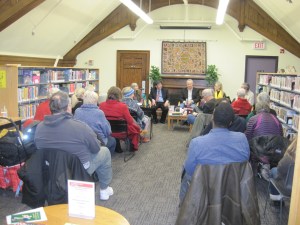
Two more things, one I’ve learned from experience. If you live where winter can be iffy with weather that can be blizzards, mixed precipitation and the like, you don’t do in-person presentations, readings or teach courses. I have managed to be lucky with teaching workshops in March and even February and evena couple of readings in February. But there have been very iffy ones due to weather in late March. That was the case with the Crime Writers of Canada panel I was on at the Gerrard/Ashdale library the past March. It got put on hold when the weather forecast was mixed precipitation and that’s what we got. The librarian there didn’t want us to cancel but was prepared to wait until the morning of (the panel was in the evening), so I emailed the other four panelists that it might be cancelled. When the librarian phoned me the morning of, she convinced me to not cancel. So I had to phone the four other panelists. It was just rain in the early to late evening and we packed them in to a very lively interactive discussion. The librarian took photos and the close-up on is at the bottom of the home page of my website. The long shot of the audience is at the bottom of this blog post.

Those winter months are for planning, social media PR and writing, writing, writing,.

There is also one more thing I did and I recommend it to anyone trying to promote their books – whether trade published or self-published. Sign up for the free Build Book Buzz weekly newsletter and the much more Sandra Beckwith offers with that. Check out the website for more information. I can’t say enough on how much it has opened my eyes to marketing my books and it isn’t all social media but that is a part of it. There are free webinars offered and…well you can check it out for yourself. And a disclaimer: Sandra Beckwith hasn’t hired me to do publicity. I just like to pass along info about something good to help other authors.

So happy and prosperous book marketing..And oh yes, the usual – click on the Beyond Blood icon at the top and see where it leads you.

Cheers.

Sharon A. Crawford

Longshot of the Gerrard Ashdale library CWC presentation in March 2016

Longshot of the Gerrard Ashdale library CWC presentation in March 2016


Tags: , , , , , , , , , , , ,

Clearing the decks to write your fiction

Clearing the decks to write your fiction

This may be a case of do as I say, not what I do. But the past month and a half I have been inundated with unnecessary crap getting in the way of my fiction writing. A lot of it comes from what I refer to as “outside” – things like house repairs, computer problems, friends and others interrupting during my work time.. Then there are health issues and some things that I have something to do with happening.

Last Thursday Shane, the editor at my publisher’s (Blue Denim Press) came over for us to practice our authors’ skit for the Urban Folk Art Festival (Our skit went very well there and when Shane emails me some of the photos someone else took of us, I’ can post them). We also had a heart-to-heart talk about my third Beyond fiction book, which seems to be in a perpetual state of rewrite (see above paragraph for why). He is definitely interested in publishing it and is thinking of next fall (2017). We also discussed the book’s content and even a next book in the series. He also gave me a deadline.

This talk, particularly hope for publication and when, as well as a submission deadline has kick-started me into action. And so I am making changes in my life and some things will be no-nos during writing time, some things will go in the Pending file for at least a month, some things I just won’t do (yesterday I said “no” to something and it felt good); other things are getting the boot.

Am still fine-tuning the whole business as I go, but so far I am trying to do these:

  1. Specific time-frame to work on my fiction with flexibility for writing meetings and book promo events that come up. Like Shane is doing with his fiction writing, I am assigning two days a week for just that – rewriting my novel. And for flexibility, yesterday afternoon is flipped to this afternoon because of a writing group meeting yesterday. I did get some writing done on the novel yesterday morning.NOTE: I do write other things and have editing clients and teach writing. That is for other days and workshops sometimes evenings, but again for days, I try to be flexible. It is all writing and writing-related business
  2. Book PR is limited to one thing a weekday. Public readings and the like are on top of this.
  3. I set a timer for half an hour mornings to do business email .Personal email is for outside my business hours (except for my son) which are roughly 9.30 a.m. to 5.30 p.m.
  4. Make more of an effort to get started at 9.30 a.m.Sometimes difficult with chronic health issues and house repairs.
  5. Get more sleep at night. Can’ control the insomnia but have to make an effort to get to bed earlier.
  6. I’m letting my friends know what has been on my voice mail for ages but some don’t seem to get it, i.e., personal calls evenings and weekends only.
  7. This one I’ve been doing for some time and it’s outside of business hours too – don’t pick up the phone for possible telemarketers and if I get someone trying to sell me something I just yell out “Not interested” or if they ask for “Mr. or Mrs. Crawford” I reply – no one here by that name (true. I’m divorced) and you have the wrong number.” If I’m really angry I then yell “And get me off your bloody list.: Then I hang up.
  8. Try to keep the house maintenance/repairs out of my business hours and that one is hard when someone has to come to clear out your damn eavestroughs at least three times because of all the leaves falling and clogging it up.
  9. Keep getting back to utilities and the like for their screw-ups, problems, etc. to after my business hours if possible.
  10. The garden fall clean-up winter prep kept outside of business hours, although it is okay to do a bit at lunchtime, especially with Eastern Standard time returning this weekend.
  11. And this one – some of you might think I’m being mean here. But I’m putting on hold so-called friends who are unreliable and don’t show up (and don’t let me know that they can’t make it for dinners and the like we plan to meet up for – we all have things that crop up, but let me know before the meet-up that you can’t make it.

Hopefully ,I will now have my time to finish rewriting my novel. Up to now this week, I have been making some progress.  I know it is because I’m starting to get some control of my life – at least some of it. Now, if the computer problems and issues would stop, that would give me more time too.

How do you make time for your writing? Everyone’s circumstances are different. I am lucky in that I work mostly from my home office.

Cheers.

Sharon

I am taking part in the Toronto Heliconian Club Literature Section Salon (dinner and readings) next Tuesday afternoon. I am a member and will be reading an excerpt form a short story in Beyond the Tripping Point. More details in my Gigs and Blog Tours Page here.

Again, click on the Beyond Blood icon at the top to get to one place where print and e-copies are available.

And this, updating events on my website and the Gigs and Blogs Page (and the other social media links) constitute my book PR for today.


Tags: , , , , , , , , ,