RSS

Tag Archives: Novel writing

Working birthdays into your novels

The latest Beyond book in the series

The latest Beyond book in the series

Probably because today is my birthday it got me thinking about how to work in birthdays for your main fiction characters. Doing something different in the plot instead of just the character having a birthday party. Or in the case of the fraternal twin PIs Dana  Bowman and Bast Overture in the current Beyond mystery (which I’m still rewriting) who turn 40 in the book. I am avoiding the cliche throw a 40 surprise birthday party. I have also added in that their birthday is December 31 so we have New Year’s Eve as well. Double celebration here, but not just party- party – there are plot twists and revelations and I’ve put all this birthday/New Year’s Eve stuff at the end of the novel. And it is not only December 31, but December 31, 1999 so going into the new (then) 21st. century.  Bast is a computer geek so some of us will remember the big Y2K scare at that time. Yes, that’s involved but I’m not saying how.

What I am saying is there are ways to incorporate typical life happenings and events into your novel but be unique in your plot about it. Another example from this Beyond book is the pushing 40 syndrome, although in 2016 it might be “pushing 60” not 40. Remember my book set in late 1999. Yes, the twins have some anxiety about reaching the big 40, but it’s more than that as both have life intervening events that play a part in their angst. Especially Dana.

And I’m not saying what. Just a few tips to sum up how to incorporate normal life events into your fiction.

For specific holidays, have something different about them and I don ‘t meant just the location. Christmas is a big one. I jump from mid December to New Year’s Eve with just a sentence referencing Christmas in that chapter. While I love Christmas movies – olnd new – I think Christmas plots have been overdone, at least in film. “Different” is the key word here.

For characters birthdays, again, make it different and that can be done by tying it into the plot. Your character pushing 40, 50 or whatever, can help them decide to make a big change in their life – but what is the change? Depending on the genre, they might want to let their inner desires come to the surface and act on them. Use your imagination for what that can be.They might be so fed up with their life situation (which will be in your plot) they decide to disappear for good. Instead of telling your story from the other, main characters about after the character disappears, why not go with the disappearing character and what he or she is dealing with. Is it as he or she expected? Or different?

“Different” again is the key word here. You don’t want to write the same old, same old. So brainstorm. Let your mind wander. This often works best when you are doing something else. You know when you are trying to think of something (with me it is people’s names, a sure sign of getting old(er), don’t think about it and it will come to you.

Having said that, just the act of sitting at your computer and creating and getting in that well, creative – out-of-your-normal- world zone can also bring about some interesting and different plot ideas. Is your character directing this? Maybe. Sometimes I think Dana Bowman is in my head. She certainly thinks she is.

Happy and creative writing.

Cheers.

Sharon

And the  usual, click on the Beyond Blood graphic at the top to go to my author profile and books and where to purchase. Christmas is only 25 days away.

And I don’t have most of my Christmas decorations up. Too busy writing and editing.


Tags: , , , , , , , , , , , ,

Following your muse when rewriting novels

The latest Beyond book in the series

The latest Beyond book in the series

The more I rewrite my third Beyond mystery book, the more I learn about fiction writing. It is not all about making sure plot line works and is consistent and that characters are believable. The muse, that nebulous creative force does factor in. And not only when you are sitting at your computer, but when you are busy doing other things.

I can be making dinner, going for a walk (although not too much of that lately with our November weather) or even be asleep, when suddenly something will pop into my head to include in my novel. Sometimes it is an answer for some plot and/or character problem. But often it is something completely different that will work. Sometimes it is a reminder about what is missing.

The latter that happened with me is about my main character, PI Dana Bowman and is about including more emotion with her, especially after she suffers a severe trauma at the end of Part 1 in the novel. The novel’s first chapter has her feelings upfront and centre. She is feeling down and the weather (rain in November no less) is making it worse. She also runs into Don Fielding, the Detective Sergeant she met in Beyond Blood and where she ignored their attraction to each other. So, that comes up in the beginning of the new novel.

I have included the aftermath of her traumatic experience – emotional and physical but something still needs to be included near the end and the end of the novel. And so, the elusive muse brought this to me as well as an idea of how to write it.

Lesson learned? Let your mind (and body, too) go on to non-writing activities and get some sleep to give the muse the space to show up.

We writers need all the help we can get. Unlike some writers who claim they hate writing, I love writing, no matter how difficult it can sometimes get. What I don’t like is all the other stuff I have to do and the time it takes.

Well, now I have found something positive about doing housework, but with a disclaimer here. I do like to cook (and eat too), partly because it is something creative.

So, does doing one thing that is creative help another thing that is creative?

Speaking about Muses and being creative, a reminder for those in the Toronto, Ontario area. This Saturday, November 26 I will be participating in the Toronto Heliconian Club’s Gifts from the Muses Show and Sale – selling my Beyond books and reading an excerpt from Beyond Blood at the end of the 2 p.m. entertainment session – I’m after the musician then. More details here.

And if you can’t make it, the Beyond Blood icon at the top of this post links to my amazon profile – which also shows the Beyond the Tripping Point short story collection. Might make good Christmas gifts.

Cheers.

Sharon A. Crawford

Gift of the Muses Show and Sale

Gift of the Muses Show and Sale


Tags: , , , , , , , , , , , ,

Clearing the decks to write your fiction

Clearing the decks to write your fiction

This may be a case of do as I say, not what I do. But the past month and a half I have been inundated with unnecessary crap getting in the way of my fiction writing. A lot of it comes from what I refer to as “outside” – things like house repairs, computer problems, friends and others interrupting during my work time.. Then there are health issues and some things that I have something to do with happening.

Last Thursday Shane, the editor at my publisher’s (Blue Denim Press) came over for us to practice our authors’ skit for the Urban Folk Art Festival (Our skit went very well there and when Shane emails me some of the photos someone else took of us, I’ can post them). We also had a heart-to-heart talk about my third Beyond fiction book, which seems to be in a perpetual state of rewrite (see above paragraph for why). He is definitely interested in publishing it and is thinking of next fall (2017). We also discussed the book’s content and even a next book in the series. He also gave me a deadline.

This talk, particularly hope for publication and when, as well as a submission deadline has kick-started me into action. And so I am making changes in my life and some things will be no-nos during writing time, some things will go in the Pending file for at least a month, some things I just won’t do (yesterday I said “no” to something and it felt good); other things are getting the boot.

Am still fine-tuning the whole business as I go, but so far I am trying to do these:

  1. Specific time-frame to work on my fiction with flexibility for writing meetings and book promo events that come up. Like Shane is doing with his fiction writing, I am assigning two days a week for just that – rewriting my novel. And for flexibility, yesterday afternoon is flipped to this afternoon because of a writing group meeting yesterday. I did get some writing done on the novel yesterday morning.NOTE: I do write other things and have editing clients and teach writing. That is for other days and workshops sometimes evenings, but again for days, I try to be flexible. It is all writing and writing-related business
  2. Book PR is limited to one thing a weekday. Public readings and the like are on top of this.
  3. I set a timer for half an hour mornings to do business email .Personal email is for outside my business hours (except for my son) which are roughly 9.30 a.m. to 5.30 p.m.
  4. Make more of an effort to get started at 9.30 a.m.Sometimes difficult with chronic health issues and house repairs.
  5. Get more sleep at night. Can’ control the insomnia but have to make an effort to get to bed earlier.
  6. I’m letting my friends know what has been on my voice mail for ages but some don’t seem to get it, i.e., personal calls evenings and weekends only.
  7. This one I’ve been doing for some time and it’s outside of business hours too – don’t pick up the phone for possible telemarketers and if I get someone trying to sell me something I just yell out “Not interested” or if they ask for “Mr. or Mrs. Crawford” I reply – no one here by that name (true. I’m divorced) and you have the wrong number.” If I’m really angry I then yell “And get me off your bloody list.: Then I hang up.
  8. Try to keep the house maintenance/repairs out of my business hours and that one is hard when someone has to come to clear out your damn eavestroughs at least three times because of all the leaves falling and clogging it up.
  9. Keep getting back to utilities and the like for their screw-ups, problems, etc. to after my business hours if possible.
  10. The garden fall clean-up winter prep kept outside of business hours, although it is okay to do a bit at lunchtime, especially with Eastern Standard time returning this weekend.
  11. And this one – some of you might think I’m being mean here. But I’m putting on hold so-called friends who are unreliable and don’t show up (and don’t let me know that they can’t make it for dinners and the like we plan to meet up for – we all have things that crop up, but let me know before the meet-up that you can’t make it.

Hopefully ,I will now have my time to finish rewriting my novel. Up to now this week, I have been making some progress.  I know it is because I’m starting to get some control of my life – at least some of it. Now, if the computer problems and issues would stop, that would give me more time too.

How do you make time for your writing? Everyone’s circumstances are different. I am lucky in that I work mostly from my home office.

Cheers.

Sharon

I am taking part in the Toronto Heliconian Club Literature Section Salon (dinner and readings) next Tuesday afternoon. I am a member and will be reading an excerpt form a short story in Beyond the Tripping Point. More details in my Gigs and Blog Tours Page here.

Again, click on the Beyond Blood icon at the top to get to one place where print and e-copies are available.

And this, updating events on my website and the Gigs and Blogs Page (and the other social media links) constitute my book PR for today.


Tags: , , , , , , , , ,

Developing fiction characters from observation

The latest Beyond book in the series

The latest Beyond book in the series

Here are a couple of excerpts from the Developing Characters and Dialogue in Fiction workshop I taught this past Tuesday.

If you want to get your dialogue bang on with your characters, here are some tips:

Listen, watch and read who and what are out there. That could be a TV series, a movie, a book, and in-person. A couple of TV series with excellent and diversified characters (each quirky in their own way) are NCIS:LA. Even if you are not an NCIS fan, the two sets of investigator partners are priceless – not only to watch for entertainment but to study as a fiction writer. Briefly.  the one set consists of Deeks who is actually an LA detective transferred to NCIS. He tends to run off at the mouth and fixates on weird things in life. His partner (professional and personal in the series) Kensey is so different – she is the slob in this duo and likes to pick on Deeks. The other duo, in a nutshell, Sam and Callen – Sam black and Callen is white but they are different in personalities and lifestyles. Sam has been married for many years to another agent, Michelle and they have two children including an adult son in the military. Callen is a minimalist in his life and has problems with committment.

I suggest checking out reruns of NCIS:LA as Kensey is in a coma from a severe injury for the next few episodes as the actress playing her is on maternity leave. But there are other interesting unique characters in the series including the unit’s second in command played by Linda Hunt.

Another series with quirky characters is the British Heartbeat. It ran from around 1992 to 2010 but repeats are shown on various TV stations or you can probably see it there or on alternative viewing. Heartbeat is set in the late 1960s in a fictitious small town in North Yorkshire, England. It focuses on small town policing operating from Ainsfield station at that time and is intertwined with some of the social issues then.  Not all the characters are cops, but all characters are so well developed and except for a core few, the characters do come and go over the years. My favourites are Mr, Greengrass who is an elderly con artist with the most disgusting dog you may have ever seen, and Oscar Blaketon who is the Sergeant in charge of the police station until he takes early retirement due to health issues. Then he becomes a postal clerk and then co-owner of  the pub which is also central to the series. Blaketon is an interferring know-it all and keeps that up even after he retires.

Another way to absorb characters is to listen. A writer I know wanted to find out how teenagers speak so she would go to where they hung out and listen without butting in. Getting the slang and other language peculiar to your characters often requires this up-front listening. I also like to listen in on loud cell phone conversations when travelling on public transit – although there is not as much of that now with people texting.

The idea is to observe and absorb but not steal characters from TV, film, books or real life. And if your character has disabilities, you might want to actually interview someone with the same disability and also try to live in their shoes, so to speak, for a bit of firsthand feelings. For example, life in a wheelchair is so much different and not just operating the wheelchair and getting through doors. The view is a bit different. Just a caution: if you are going to get the feel of being blind, it might be a good idea to have another person with you for safety’s sake.

As for me I had a six-day experience of being 85 percent deaf. It was terrifying going into a grocery store and trying to read people’s lips. The only thing I heard was two people yelling and it must have been quite loud for me to hear it.

It was only temporary – ear wax. Who what have thought that?

How do you create distinctive characters in your fiction?

Cheers.

Sharon A. Crawford

And as usual, the Beyond Blood book icon at the top takes you to one of the places with my profile and books.


Tags: , , , , , , , ,

Using fictional characters’ inner thoughts for character development

The latest Beyond book in the series

The latest Beyond book in the series

We’ve all read fiction where the characters come across as superficial. I’m not referring to their traits (and superficiality may well be one of them). Instead, I’m referring to characters that don’t evoke a strong reaction from the reader, characters that  don’t connect in some way to the reader, characters that leave the reader thinking “Who cares?”. Chances are fiction with characters that the reader can’t seem to get into means that the writer doesn’t really know their characters. The writer didn’t get inside each haracter s’ head.

Getting inside your protagonist’s or antagonist’s head is key to understanding them and bringing them to life to your readers. Here’s a short excerpt from my novel Beyond Blood to illustrate this.

Chapter Twelve:

David:

He had woken up to cold and darkness. Beechnut. Where was Beechnut? He was lying on his back and tried to sit up but his arms were stuck in front of him and his feet were stuck together. Shadows seemed to come at him.

“Mom … mee,” David said. “Mom … mee. Where are you? Mom … mee, I’m scared.”

No answer. Where was he? Where were Mommy and Uncle Bast? Where was Debbie? They’d been reading Alice in Wonderland. Then he had gotten hungry and run downstairs to the kitchen with Debbie after him. It was a game they always played. When he’d heard a noise in the basement he’d run down there and seen one of Mommy’s friends playing the game, so he’d chased after … and then … he couldn’t remember. His head hurt and he felt a little sick. He tried to move his hands again, but couldn’t. They were still stuck together.

Where was he? His toes hurt. His teeth hurt and he was so cold.

“Mom … mee. Mom … mee.” Now he was yelling.

A door burst open and something thudded in.

Oh no, a monster. Coming after him.

“Mom … mee. Mom … mee. I’m scared.”

He heard a click and a bright light blinded his eyes.

“Pipe down,” a voice shouted at him from above, or was it beside him?

“Who are you? I want my mommy. I want Beechnut.”

Instead he felt something heavy and sticky cover his mouth. The bright light clicked off and footsteps receded to the doorway, and then he heard a door slam.

In darkness and alone, David began to cry, his sobs muffled by the tape over his mouth.(From Beyond Blood, copyright Sharon A. Crawford, Blue Denim Press,2014).

It is probably obvious that David has been kidnapped and that he is a small child (he is six). Here the reader finds out how David feels about this from first discovering he is not at home and his Mommy is not around. The reader can feel for David, can feel his fear and despair.

Of course not all characters get kidnapped. Some fall in love; some are con artists, etc. The writer needs to convey all this to the reader and getting inside the character’s head is one way to do this.

There are other ways to develop characters. I will be teaching a workshop on Developing Characters and Dialogue in Fiction next Tuesday, Oct. 11 at the S. Walter Stewart library branch in Toronto, Canada. If you are in the area and want to attend, it is free. The library prefers you to register first (call 416-396-3975) , but you can just show up at 6.30 p.m. Workshop runs to 8 p.m. Here are the details about it.

Developing Characters and Dialogue in Fiction

Tuesday, October 11, 2016

Learn how to show, not tell, to develop credible characters and make their dialogue sing. Uses excerpts from Beyond the Tripping Point and Beyond Blood by Sharon A. Crawford to illustrate. Writing exercises and some writing critique.

Facebook Event

Location:
S. Walter Stewart Library Branch (auditorium)
170 Memorial Park Ave.
(Coxwell Ave. and Mortimer Ave. area)
Toronto, Ontario

Time:
6.30 p.m. to 8 p.m.

And if you are interested in reading more about developing characters but can’t make the workshop (for obvious reasons such as you live in another part of the world), you can click on the Beyond Blood icon at the top and that will take you to my publisher’s website where you can see my profile and where my books are available online and elsewhere. I didn’t do the usual link to Amazon because they have the incorrect price for my mystery short story collection Beyond the Tripping Point. It is not $94.36. I have contacted Amazon about this error so hopefully it will be corrected shortly.

It would be nice to get that much from a book, but who will buy it at that price? Somebody with big fingers on little keys maybe entered the amount?

Cheers.

Sharon


Tags: , , , , , , , , , ,

Getting Started Writing That Book

Sharon A. Crawford's latest in the Beyond series

Sharon A. Crawford’s latest in the Beyond series

A friend wants to write a book and is having trouble getting started. She has done the necessary research and her mind is overflowing with ideas. But actually sitting down at the computer and writing it is presenting a problem. I know that feeling of having too many ideas brewing and circulating in the mind – even AFTER I have begun writing my books .

Both my friend and I have journalist backgrounds and I wonder if that has something to do with it. Journalists are known for collecting way too much information and many procrastinate about actually starting. But journalists often do an outline first to narrow down what exactly the want to include in their story. When I wrote newspaper and magazine articles, that’s what I did. I also had one peculiarity. I had to get at least a good draft of the story lead before I could write further. And I’ve mentioned this before, for one story I had four possible beginnings and not until I phoned another journalist and read out the four beginnings and she chose one, could I proceed further.

Some of these journalist habits can be transferred to books – fiction and non-fiction. In particular, do an outline. Some writers seem to be afraid to do an outline but if you remember that it is not sealed in granite and changes are possible as you actually write the book (and that is so usual with fiction), it can free you to do an outline.

Or if you don’t want to actually do an outline, do a list of the most important ideas and information you have. Often just getting it down, frees the chaos in your mind and also gives you some reference points.

I still try to get a good beginning draft, but try to keep in mind that it will probably change. Just yesterday, while doing more rewriting of my next Beyond novel, I changed the beginning somewhat – more the presentation than actual content. And yes, it came from an idea percolating in my head (plus a previous comment from the editor at my publisher’s about how I was handling a certain aspect of the novel, which included the beginning). In my case, the focus was coming up with something different in presentation and format from Beyond Blood.

If you still can’t get started and freeze in front of the computer, maybe try some freefall writing to unlock your creativity. Think of an emotion you are feeling now, or something bothering you in your life and just start writing about it for 15 to 20 minutes. Stop only to breathe (although you probably won’t even notice that you are still breathing). Go where the emotion you are feeling leads you. Go where the words lead you. You might go off on a tangent you hadn’t anticipated.

And you might just get writing something you can use in your book.

At any rate, your creativity will  be unleashed and your self-confidence will get a boost.

I also suggest reading Julie Cameron’s book The Artist’s Way for her ideas on getting going with your writing. Because the other thing is you have to set out some regular writing time and days and stick to it. Treat it like  your job and the payoff isn’t necessarily in money, at this point, but a book manuscript that you are finally starting to write.

Cheers.

Sharon

And the usual, click on the Beyond Blood icon at the top for more info about my books and go to the Gigs and Blog Tours Page for more information on my upcoming author events.


Tags: , , , , , , , , , ,

Rewriting Novels Using Both Sides of the Brain

Sharon A. Crawford's latest in the Beyond series

Sharon A. Crawford’s latest in the Beyond series

Rewriting a novel can be daunting, especially with the many, many rewrites that are necessary. I find there is no right way to do it, but with all the rewrites with my third Beyond book, I discovered by accident a way to be both creative and practical.

Use both sides of your brain – the right side for creativity and the left side for the logical and practical. Let me explain.

Without giving away the plot, let’s just say, like most of my story lines, it is complicated. That means the characters, like real people are complicated.

So I brainstorm outside of writing time for what I could change. When I sit down at the computer, I re-read all the novel and make a few notes. Then I tackle it from the beginning, dealing with it in parts. As I write more ideas come into my brain. But each idea leads to something that will have to be added or changed later on in the novel. So how do I keep track. Sure, I can make a few notes in another file, but mainly I use the Word comment for this with some suggestions.Then I can go back and update later. However, often the creative spirit married to the logical spirit moves me to do so right away. So I follow the thread to the next part that needs changing and do so.

I’ll give you one example which won’t give the story away. My Beyond novels, as well as four stories in Beyond the Tripping Point, feature fraternal twin private investigators, Dana Bowman and Bast Overture. While they partner in their business, they do split up the investigation a lot of the time. One of the things with this is the twins have to keep each other updated with what they find. So that has to go in somehow somewhere or else later on I will be writing from say Bast’s point of view as if he already knows what Dana found out – but nowhere does it say this.The reader can’t assume Dana told him. But I don’t always want a long dialogue between the two unless it can move the plot forward and/or develop the characters.

So, I sometimes use the phrase “Bast brought Dana up to speed about….” or “Dana brought Bast up to speed about…” Sometimes I don’t even do that but just have Bast in his next investigative action think “Dana had told him that… ” and very briefly mention it. I  do the same with Dana and do so when what one twin told the other is relevant to the other twin’s current detecting.

But with all this to-ing and fro-ing something else different has come up – what would happen if one twin didn’t tell the other twin what he or she found out?

Yes, it can be a somewhat constant shifting to different parts of the brain and I find that one feeds the other. And often you are rewriting on the creative side during most of that day’s writing time.

Now if I can just follow through with my rewrite of Beyond….  Nope, not even giving away the title.

Meantime, you can check out Beyond Blood and Beyond the Tripping Point. Link to all that can be found in the usual spot – the book cover at the top.

And later this month I will be back on the PR road for the Beyond books, so next week will be updating both the Gigs and Blog Tours part of this blog (a fiction writing workshop I’m teaching in October is already listed) and also the book page of my website. And yes, Dana will be doing another comedy skit gig in late October – this time with a really big twist. Stay tuned.

Cheers.

Sharon. A. Crawford


Tags: , , , , , , , , , ,

More on your setting in fiction

The latest Beyond book in the series

The latest Beyond book in the series

Besides actual location, setting also includes information peculiar to what is happening in the location. For example, in my novel Beyond Blood, the main character PI Dana Bowman goes sailing with Detective Sergeant Donald Fielding. Fielding has been sailing for years but this is Dana’s first time aboard a large sailboat – more like a small yacht. So I combined my limited sailing background with checking in with an expert in this area and also some reading online and in books about sailing..

A few years ago I wrote a newspaper story on a fellow, a seasoned sailor, who was planning to sail at least partway around the world. His “sailboat” (the small yacht type) was anchored in the Harbourfront area of Toronto Harbour. I made an appointment to interview him for the story and met him on his boat. When I arrived he was swabbing the deck.

I told him I was also going to ask a few extra questions for background information for a novel I was writing. He gave me the boat tour – it is amazing what can be packed into the small enclosed area below – everything from a small kitchen to a bathroom to a place to sleep. He was very informative but he did not take me out on Lake Ontario. So, I had to go back a few years when my son, still a child, and I went sailing with my friend and her boyfriend – for the feel of it, to remember you always wear a life jacket when on a sailboat, to how the winds affect the sailing, to falling into the water. No, I (who can’t swim) didn’t fall in, but my friend, a good swimmer did. She was okay with her life jacket on and just laughed about it as she swam the short distance back to the boat and climbed back aboard. But it gave me information for Beyond Blood although no one falls in the water.

So when Dana first goes out on the water with Fielding, I work it in as a friendly lesson while avoiding making it an expository or Sailing 101. Here is a short excerpt:

“Here put on a life jacket.” He handed me one which I donned. Fielding put on the other one and shoved the cooler under the floor. “Please sit down while I hoist the sail.”

” Need any help?”

“No.” He looked into my face. “Fine, but you have to obey orders if you want to crew.”

“Aye, aye sir.” I saluted,

Fielding moved away and moved into what resembled a cockpit, lowered the centreboard and removed the tarp, exposing two sails.”

“Here, store the tier below deck.”

“Huh?”

Fielding pointed to where the cooler rested. Taking hold of the tier, I folded it and placed it below deck.

“Maybe I’ll just watch this time.” I sat down on one of the benches.  (From Beyond  Blood, copyright Sharon A. Crawford, 2014, Blue Denim Press)

Dana does help more a bit later. The whole chapter is not about learning to sail as Fielding and Dana also use the time to find out more about each other until…

Well, I’m not going to say what happens or how this chapter ends.You’ll have to read Beyond Blood to find out. Click on the book cover at the top to find out one of the places the book is available. For now,  I’ll just say that later in the novel, Dana has to use her sailing knowledge to try to save a family member. So, the first sailing episode was not just a respite from all the murder and mayhem, but also served a purpose – showing how Dana learns something about sailing so that when she has to use it in a life-threatening situation, it is not a skill pulled out of air with a quick explanation such as “I (Dana) learned to swim a few years ago” tacked on to it.

That is something else to remember. You may have more leeway in a novel to go off on so-called tangents, but make sure they have something to do with character development and plot – especially in mystery novels.

Cheers.

Sharon A. Crawford


Tags: , , , , , , , , , ,

Fiction Setting in past times

The latest Beyond book in the series

The latest Beyond book in the series

Some of us write fiction set in past times. That could be from last year back several decades or centuries. My Beyond stories are set in the late 1990s, so many things were different even back then 17 or 18 years ago.For example, technology could be considered part of setting (think wi-fi availability today in cafes, public transit, and just walking along the street). What we take for granted today, may not have been around back in the days of your novel or short story.

One big setting factor is weather. We can all probably figure out that today’s weather is much more extreme in all ways. There are more floods, tornadoes, heavy snowfalls, etc. And so if you are writing in another time period, you have to be aware what is going on in the weather then. And not in general, but on the days your story takes place and the actual location. That requires some research beyond your memory of back then if you were actually living in that time period. Leave your memory of the weather for your feelings about it when it happened and you might be able to use that in your story. You need to do more concrete research.

If you don’t something like the following could happen.

Supposing you are setting your story in August 2011 in Goderich, Ontario, Canada. You have been there many times in the past, but not since 2010. So, you write your story setting it in August 2011 in Goderich as you remember it with its centre of town set up in a square..

Hold it right here. On August 21, 2011 a big tornado hit Goderich, Ontario causing extensive damage to the downtown square and nearby houses. If you have your characters meeting at one of the shops there or even in a chase through the downtown square on that date or just after, but don’t factor in the tornado, oops.

A tornado can add to the suspense in your story, so consider including it.

But do your research first – online with old news stories.And if you don’t know what the weather was like on certain days of certain years, you can check with weather authorities (such as Environment Canada) for historical weather information about dates in the past. You don’t want to have a blizzard in late November in such-and-such year just north of Toronto when the weather was actually mild for the time and it rained the proverbially buckets.

There are many other time-related issues that factor into setting. I’ll cover a few more of them in a future post, but here’s one to think about and research.

Your characters are eating soup that came out of a can and the year is 1921. Did soup or any other foods come in cans in 1921? You need to do your research. And you can take that food area much further to what people actually ate in the your story’s time period and how they prepared and stored food and where and how they ate.

Setting covers much more than geographic location.

Cheers.

Sharon A. Crawford


Tags: , , , , , ,

Being Dana – precautions when getting inside fiction characters

The latest Beyond book in the series

The latest Beyond book in the series

Dana Bowman is the main character in Beyond Blood. Because some of the novel is told from her viewpoint in first person singular, I get inside her head a lot. Of course, Dana thinks it is her getting inside my head.

Could be.

That’s where fiction authors have to be somewhat careful. How much of what your character thinks, does and says is him or her and how much is you? While it is true that some of our quirks rub off on our characters, they are distinct “people” at least between the book covers or in e-books, and in your head.

Add to all this head business is my comedy skits where I actually become Dana Bowman. Again, have to make sure I’m channelling her, not me and she talks and acts as Dana, not Sharon. I try to use the black wig as my changing point.Black wig on I’m Dana; black wig off I’m me. And no, I don’t wear the wig when I’m writing – or as I am doing now – rewriting the next Beyond book.

This brings up something else I’m having to deal with. Without going into a lot of details, Dana suffers some sort of injury in the latest book. What happens has not exactly happened to me – yet. So, besides doing the medical research, to understand better what Dana is going through, I went back (in my mind) to similar injuries I have suffered. How did I react? How did I feel right after it happened? Later? Injury consequences.

Earlier this summer I was at an open garden held by a member of my garden club. I had never been to her place before and because we were encouraged to walk all over the property outside, I entered the property by walking on the front lawn. After seeing the garden in the backyard, asking questions, and talking to the garden’s owner and other club members, I decided to return home.

This time I left by the normal route out front – used the cement walkway to the public sidewalk.

Except when I got to the end of the walkway I lost my footing and went flying forward, landing on my front on the hard cement sidewalk and injuring my knee – big wide cut, bleeding.

Shock, was what I felt. And anger – although the latter was not directed at the culprit – yet. Many people helped me up and one fellow lined up my purse and hat which had fallen off. Many (included the owner) brought out some first aid stuff and one couple drove me home (it was a 10 minute walk but I wanted to get antiseptic on my knee before putting on the gauze and band-aids to hold the gauze in place as soon as possible. I was deathly afraid of infection (because I had been bitten by flying ants a couple of summers ago and the areas did get infected). After the cleanup at home I headed over to the drugstore for more band-aids and gauze.

Later, like the next day, I began to re-direct my anger – at the homeowner. The step was deeper than a curbside step (from sidewalk to road) and unseen – no handrails, so unless you were familiar with the area you would not know the step was there. I wanted to report the homeowner’s negligence to the City – there is probably a bylaw for something like this. But I decided that if my injury didn’t become infected I wouldn’t do that, but would have a serious “chat” with the homeowner next time I see her. The injury didn’t become infected although at one point it looked like it might be and I rushed over to the walk-in medical clinic near my place. I haven’t yet talked to the property owner, because I haven’t made it to any garden club events since then.

How does that translate to Dana and her situation? Well, the fall part, the shock at it happening, the loss of control and the fear afterwards – that’s what I can draw on. The rest for Dana has to be different because she does not fall down an unseen step. Also she is 27 years younger than me, so “seniors and falls” doesn’t come into play.

What happened to me gives me some idea of something bad physically happening, something that is unexpected and how Dana could feel.

So, if you can pull something out of your life that occurred to get the feelings at least, it can help you get inside your character’s head when he or she has something bad happen that is similar.

Now I just have to contend with Dana’s chattering inside my head.

Who is really in control here?

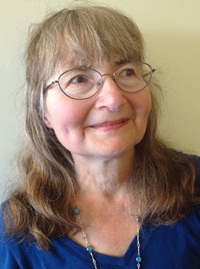
If you want a look at Dana Bowman as I see her (and others when I do a comedy skit), her picture is below. For more info on her check out my website book page. You can see what I look like (on my good days) at the top of this blog

And you can check out my author profile at amazon by clicking on the Beyond Blood book cover at the top.

Cheers.

Sharon A. Crawford

Sharon A. Crawford channelling Dana Bowman from Beyond Blood


Tags: , , , , , , , , , , ,