RSS

Tag Archives: toronto public library

Crime wave hits Gerrard Ashdale library March 24

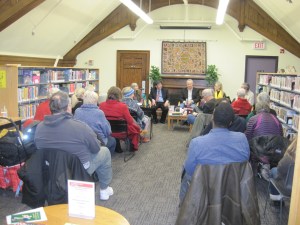
Longshot of the Gerrard Ashdale library CWC presentation

Longshot of the Gerrard Ashdale library CWC presentation

At 6.30 p.m., March 24, 2016 an unusual crime wave hit the Gerrard Ashdale branch of the Toronto Public Library. Downstairs, the dead body outline was “drawn” with masking tape. Upstairs, “crime” was in progress – at least between the book covers, and expanding to the audience facing the five crime writers in the front.

For the next hour and a half, true crime writers Mark Eddy and Nate Hendley and crime fiction authors Lisa de Nikolits, Steve Shrott and Sharon A. Crawford (also moderating to keep the crime enthusiasts on track) discussed various aspects of crime writing and reading – from authors’ and readers’ view points.

Besides the why we write what we do (Lisa and I have social justice as our reasons and Mark Eddy, author of The Recent History of Terrorism in Canada 1963 -2013, wrote that book because Canadian literature didn’t have this history published). We also discussed where we get our ideas. For example, many of mine come from real life incidents such as a harrowing drive up Highway 11 to cottage country with a friend when her car brakes stopped working. I take the incident and fictionalize the characters and plot.

But one of the most interesting discussions was in answer to the question:

What is your take on novel or true crime endings, i.e., should you leave the reader hanging or have a resolution that ties up the book’s contents?

Some wanted a full resolution, but some were okay with a resolution for the main plot, but some of the issues with the characters could be left hanging, especially for series novels. Nate Hendley, who (among other true crime books) wrote Steven Truscott; Decades of Injustice about Steven Truscott (who was wrongfully convicted of murder and rape at age 14,in 1959), was pleased that he could put in his book that in 2007 the Ontario Court of Appeal declared Truscott acquitted of the rape and murder of Lynn Harper. That declaration was the result of Truscott himself filing an application for this in 2001. Justice moves slow. In fiction, that can happen faster.

The five of us authors in the hot seats also discussed unusual ways we promote our books. For example, Nate Hendley had copies of his Truscott book at a presentation of a play about Truscott in southwestern Ontario. I dress up as my main Beyond Blood character, Dana Bowman and do short skits where Dana disses me. See my website for where Dana will next appear.

Meantime, here’s another photo of the CWC gang up close at Gerrard Ashdale. Both photos were taken by the library branch’s head librarian, Gail Ferguson.

Cheers.

Sharon A. Crawford
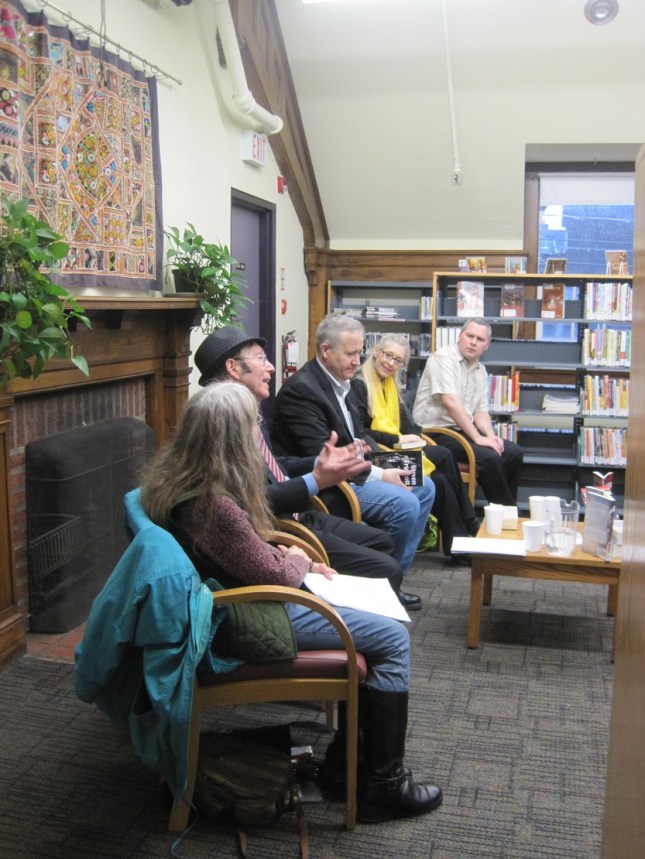
The CWC gang up close - Sharon, Steve Shrott, Nate Hendley, Lisa deNikolits, Mark Eddy

CWC gang up close – Sharon, Steve Shrott, Nate Hendley ,Lisa de Nikolits, Mark Eddy


Tags: , , , , , , , , , , , , , ,

Making your fiction characters sick

Sharon A. Crawford's latest in the Beyond series

Sharon A. Crawford’s latest in the Beyond series

I’ve talked before about giving your fiction characters tags such as jangling keys in their pocket or going silent when someone starts arguing with them. These tags show character traits and help the reader connect better with them. The first trait mentioned might occur when the character is impatient and the second opens a lot of things the author can show about the character. It might be as simple as the character hates arguing but he or she might be afraid to speak up when challenged. Both those bring up the question “Why?” in the reader’s mind. And give the author leeway to build his or her character.

Another trait that can be used is health issues – good or bad. Maybe you want your character to be an extreme fitness buff. Maybe he is passionate about playing golf. But the flip side of the coin can present even more interesting character tags – the character’s illness or an injury – the latter maybe occurring during the story. For example, the late Robert Parker in one of his Spencer novels had Spencer get shot in the chest and part of the novel dealt with his recovery and how it affected him both professionally and personally.

In my Beyond novel, Beyond Blood, I give Detective Sergeant Donald Fielding an affliction no one really wants – migraines. I know of where I write here because when I was in my early 30s (back in the grey ages, of course), I had migraines with almost the whole enchilada in symptoms. Didn’t have the aura but I did get sick to my stomach and of course the pain. And lots of treatments were tried and not all worked or were only temporary. Then there was the personal and professional repercussions. I had to postpone story interviews with subjects because I had a migraine, and one of the treatment options – blowing in a brown bag, supposedly to stop the pain (it didn’t work), was done around the kitchen table during a big party I held. My girlfriend who suggested that was coaching me and there were some onlookers around the table.

Which gave me lots of options for Fielding, I combined my personal experience with imagination for his migraine attack. Not a party, not a kitchen, but in the main character Dana Bowman’s bedroom. That’s all I’ll say about that scene except the cause of the migraine was the same as many of mine were – stress.

So you can use your personal health experience for one of your characters in your novel or short story. Just make sure it is worked into the plot and isn’t a tangent. And yes, Fielding’s migraine incident was part of the plot. Also, it could be a friend’s illness, but just make sure if the illness is yours or your friend’s that the character doesn’t turn into a copy of you or your friend. Use the illness as a character tag.

And next Thursday, March 24, I’ll be joining four other Crime Writers of Canada authors for a lively panel discussion and q and a about what and how we write. Here are the details:

Murder and Mayhem between the (book covers) at Gerrard/Ashdale library branch

March 24, 2016

Join five Crime Writers of Canada authors Sharon A. Crawford, Steve Shrott, Lisa de Nikolits (three mystery novelists) and Mark Eddy and Nate Hendley (both true crime authors) for a lively discussion about crime writing and their books. Sharon moderates this panel and the authors just might read a bit from their books. More information.

Location: Gerrard/Ashdale Toronto Public Library branch

1432 Gerrard St. E., Toronto

Time and Date: 6.30 p.m. to 8 p.m., Thursday, March 24, 2016

Maybe I’ll see some of you there.

Cheers.

Sharon

If you click on the book cover at the top, it will take you to one place where my Beyond books area available.


Tags: , , , , , , , , , , , , , , ,

How Writers in Residence can help your writing

Sharon A. Crawford's latest in the Beyond series

Sharon A. Crawford’s latest in the Beyond series

What are the advantages of having a Writer in Residence look at your writing and give feedback and marketing advice?

I’ve had the good fortune to be involved  on both sides. For two sessions I was Writer in Residence for the Canadian Authors Association Toronto branch. In that position, I have helped writers with advice on marketing their manuscripts, writing a query letter, editing and evaluating their manuscript – up to a point.

One thing about a Writer in Residence is he or she only evaluates/edits up to 20 or 30 pages – either for free or at a lower rate than normal fees. But it is worth every dollar (we don’t have pennies anymore in Canada), Euro or whatever denomination your country has. It is also worth your time because of the vast experience of Writers In Residence. They are published authors in various genres and if you pick your Writer in Residence to match your area of writing it can benefit your writing.

The process varies, but generally it involves submitting a few pages double-spaced of your writing-in-the works and then meeting with the WiR to get his or her feedback, ask questions and get some advice on how to make your manuscript sparkle and perhaps some marketing tips.

Recently, I had the experience of being on the other side of the fence. I am a member of the Toronto Heliconian Club and one of the benefits is the Writer in Residence. Just before Christmas I met with her – Dawn Promislow –  not for critique of my new Beyond novel in the works, but for an assessment of a five-page personal essay. I didn’t have to pre-submit the manuscript, just brought a couple of hard copies – one for her to look at and one for me – while we chatted.

And it was more than just a superficial chat. First, Dawn read the manuscript, then did a general overall evaluation including summing it up as good and more professional than she expected. (Note: this essay had been rewritten more times than I have fingers.) Then we went through it all line-by-line and discussed what worked, what didn’t, what could be expressed better and in fewer words, and what could be deleted. One of my concerns was to make it shorter so I could submit it to markets that require a shorter than 1300 personal essay. Previous to meeting withe Dawn I had shortened it from 1500 words to 1300 words.

It was a two-way discussion, none of this just giving advice with me listening. That’s important because the bottom line is it is my story and if I don’t have some input in the critique, I won’t really understand what needs to be done. The whole meeting took about an hour and 20 minutes.

So, besides CAA and clubs like the Heloconian, where can you find a Writer in Residence?

Try your local libraries. The Toronto Public Library system has two Writers in Residence programs a year, alternating locations with the two largest library branches – Toronto Reference Library and North York Central branch. I have submitted manuscripts over the years to WiRs at both branches. You have to have a library card for this – but library cards are free and renewed annually.

And submit is a keyword here. You have to submit up to a certain number of pages double-spaced to the library by a certain date. Then the library gets the manuscripts to the WiR and you will hear back from the library with an appointment time and date to meet with the WiR. Currently the TPL WiR is poet, memoir author, former journalist, etc. Brian Brett at Toronto Reference Library. For this session, Brian Brett will be focusing on poetry.

That’s another key. Submit something you are writing in the area of the WiR’s experience. Unlike me, who once submitted a chapter of my memoir to a literary novelist and poet. My memoir was part literary in style, but this author just didn’t get it. Another time, much earlier, I submitted one of the original chapter versions of the memoir to a well-rounded in writing experience WiR – Austin Clarke and got some excellent and thorough feedback. It was also a two-way discussion and it was Mr. Clarke’s feedback that helped me decide to actually write more chapters in a memoir.

So, a few tips for submitting your work to a Writer in Residence.

  1. Follow any submission guidelines.
  2. Make sure you match the WiR to what you are writing.
  3. Rewrite, rewrite your submission – a loose draft won’t do.
  4. Show up on time for your appointment with the WiR.
  5. Listen to what the WiR says but don’t be afraid to question and add details about what you are writing – it is not a one-way street.
  6. Don’t be afraid to ask related questions that are pressing – such as markets, copyright issues, and in the case of memoir (one I always find comes up in my memoir writing workshops) –  naming names and the fear with writing your story.

Good luck. The WiR can be the experience that helps you get your manuscript focused and inspires you to keep at it.

Cheers.

Sharon A. Crawford

To find out more about Sharon A. Crawford and where her Beyond books are available click on the Beyond Blood book above.And visit her website


Tags: , , , , , , , , , , ,

Crime Writers talk crime at Yorkville library tonight

Sharon A. Crawford's latest in the Beyond series

Sharon A. Crawford’s latest in the Beyond series

Crime can pay – at least between the book covers. Maybe not in big sales to make authors rich. But in authors connecting with each other and with readers.

That is set to happen this evening as four of us crime writers from Crime Writers of Canada – Rosemary Aubert, Robert J. Hoshowsky, Nate Hendley and me Sharon A Crawford will be talking about how we either create crime or tell it like it is. For the first time with me involved, there are two true crime reporters – Robert and Nate. Both write different aspects of true crime and both got into doing so in different ways.

On the fiction side, both Rosemary and I write series novels – hers is the award-winning Ellis Portal series. What’s interesting about Rosemary’s books is the first five were published by a large trade publisher, and at the beginning of this year she went with a small independent publisher.

I write the Beyond mystery series and am published by a small trade publisher – no awards yet, but I’m working on it.

Here are the details about the four of us and our presentation this evening.
Nate Hendley

Nate Hendley is a Toronto-based freelance writer and author of several books, primarily in the true-crime genre. Decades of Injustice, a hard-hitting look at the wrongful conviction case of Steven Truscott, is his latest book from a Canadian publisher. His website can be found at www.natehendley.com


Robert J. Hoshowsky

Robert J. Hoshowsky is the author of two True Crime books, including the Arthur Ellis-shortlisted The Last to Die: Ronald Turpin, Arthur Lucas, and the End of Capital Punishment in Canada and Unsolved: True Canadian Cold Cases, which inspired Macleans magazine to publish an entire special issue on famous murder cases. His extensive research on the last men executed in Canada has sparked an interest in the Lucas case, which is currently being investigated to determine if Lucas’ death sentence can be posthumously overturned, for the first time in Canadian history.


A former Researcher-Reporter at Macleans magazine, he has also contributed to top-rated television programs, including the Canadian version of Who Wants to be a Millionaire. His investigative work has been published in over 100 magazines and newspapers worldwide.


Much of Robert’s recent work can be found in Serial Killer Quarterly, where he has profiled such infamous murderers as Jeffrey Dahmer, Britain’s John Christie, Leonard Lake and Charles Ng, and Sheila Labarre.


Rosemary Aubert

Rosemary Aubert is the author of eighteen published books, the most recent being Don’t Forget You Love Me, the sixth in the acclaimed Ellis Portal mystery series, set in Toronto and featuring a formerly homeless judge and reluctant solver of murders. Rosemary is a popular teacher, presenter and mentor.


Sharon A. Crawford


Sharon A. Crawford, a former journalist, is a freelance memoir and fiction writer, writing consultant and instructor, and editor. Sharon is the author of the Beyond mystery series, the short story collection Beyond the Tripping Point (Blue Denim Press, 2012), and her latest novel Beyond Blood (Blue Denim Press, Fall 2014). She teaches writing workshops for Toronto Library branches. She belongs to Crime Writers of Canada, Sisters in Crime, The Toronto Heliconian Club and runs the East End Writers’ Group. Her hobbies: reading, walking and gardening act as catalysts for her next novel.

An Evening of Crime at the Yorkville Library

Thursday, Oct 22, 2015

6:30 p.m. – 8:00 p.m.

Four Canadian crime writers read from their latest works: Rosemary Aubert, Sharon Crawford, Nate Hendley,and Robert J. Hoshowsky. Sharon Crawford will interview the panel and a question and answer period will follow.

No registration required.

Yorkville Library Branch (Program Room)
22 Yorkville Ave., Toronto, Ontario.

If you are in the area this evening, please drop in.

Meantime, I have to go over the questions I’m asking the panel and make sure I’m on the ball with my answers too.

Cheers.

Sharon A. Crawford

Click on the Beyond Blood cover at the top to find out where copies are available


Tags: , , , , , , , , , , , ,

Don’t rush your writing

Sharon A. Crawford's latest in the Beyond series

Sharon A. Crawford’s latest in the Beyond series

We writers all seem to have deadlines with writing our novels or short stories. Sometimes it is the publisher’s deadline, sometimes our own. So we fret and hurry through writes and rewrites and maybe don’t write our best.

Last Saturday I had a heart-to-heart talk with the acquisitions editor at Blue Denim Press (publisher of my Beyond mystery books). Shane had a big piece of advice – Don’t rush the writing.

If you rush it, you’ll miss things, make errors and your writing will come across as hurried. This is mostly me speaking, but including some of what Shane and I discussed. Note: Shane is also a published fiction author. Both of us have missed things because of writing in too much of a hurry. His error is his business, but it was caught in time before all print copies of his new novel In the Shadow of the Conquistador were done for the book launch, etc.

I’ll tell you my stupid error – it is in the current Beyond book (third in the series), I am writing – apparently too fast because of time constraints (too much else going on in my life – the writing, editing and instructing business, health, house, social, etc.) Anyway for  those familiar with my Beyond books, they are set in the late 1990s, although this third one gets my fraternal twin PIs, Dana Bowman and Bast Overture into the beginning or 2000.

Which is neither here nor there with my writing error. In one scene Bast goes to the Toronto Reference Library to look up old addresses in the Toronto Might Street Directory. So, I had him go to the library’s former address – now the University of Toronto Bookstore. Why? I had done research there and for some reason the decade  that I did so got lost in my brain, so hence my date mixup.

I had gone there in the early 1970s. Bast went to the Toronto Reference Library in late 1999. This newer (and current) TRL location opened in 1977. My error arrived in my brain weeks after writing it, as often happens when not actually writing. You can bet I made the change next time I turned on the computer.

That is only one of the many things that can suffer if you write too fast. Try to pace yourself and make more time for your writing – either in the time spent each day/week or the whole time (months/years) spent.

If you do that, when your publisher accepts your manuscript and you sign that contract, you won’t have to worry so much when the publisher suggests some changes.

And often publishers have tight deadlines.

I am constantly trying to prioritize my life – including dumping things, saying “no” more often and putting some people and things on hold.  Still an uphill battle, but I try. And I need to try to relax more.

Cheers.

Sharon A. Crawford

Click on the Beyond Blood cover at the top to find out where copies are available


Tags: , , , , , , , , , , ,

On the book promo road again

Sharon A. Crawford's latest in the Beyond series

Sharon A. Crawford’s latest in the Beyond series

The presentation at Woodbridge library last Thursday evening was another one of those magical evenings where readers and authors connect. So much so we could have gone long beyond the end time.

Rosemary McCracken, Nate Hendley and I did our separate mini-presentations, each ending with a short reading from one of our books. Nate sat between us “the thorn between the roses” is the way he put it. Maybe, but not the author, more for what he writes – true crime. Nate talked about how he started writing books and sort of “fell” into writing about criminals and now also those wrongly convicted like Steven Truscott. Nate also read an excerpt from Steven Truscott: Decades of Injustice (Five River Publishing, 2012)

Rosemary talked about her mystery series featuring financial advisor Pat Tierney and the issues writers of book series have to face. She also discussed how writing contests have helped her get her stories (yes, she also writes short stories) published – something writers shouldn’t ignore. Rosemary read the beginning of her first Pat Tierney novel Safe Harbor (Imajin Books, 2012)

I talked about my series characters – but not from the writing a series viewpoint, but where some of them came from and the location and time period for the Beyond stories featuring the fraternal twin PIs Dana Bowman and Bast Overture and how both affect my research. I also covered a bit of the research I do and read the beginning Prologues from Beyond Blood.(Blue Denim Press, 2014)

And then we turned it over to the audience. Lots of questions – from research to journalism – I got the question on the latter to my surprise because I’m the former journalist and Nate and Rosemary continue working as freelance journalists. The questions turned into a real dialogue among authors and readers. Like we were chatting in a living room – well a somewhat large living room. Afterwards, some of the readers came up to the table to chat more with us and to buy a few books.

And some of us Crime Writers of Canada authors are going to do it again next Tuesday, Sept. 29, 6.30 p.m. to 8 p.m., this time at a library in Toronto’s west end – Runnymede branch. This time the authors are Rob Brunet, Karen Blake-Hall, Madeleine Callway and myself. No true crime, but three of us (Rob, Madeleine and I) all had our first novel published in the second half of last year. Karen writes sizzling suspense-romance. The presentation is free so if you are in the Toronto area, please come – exact address is 2178 Bloor Street West, Toronto, ON. I’m not going to put the library link because as I found out in my other blog http://www.onlychildwrites.wordpress.com) posting on Tuesday, the link for that memoir writing workshop I was teaching Tuesday evening has now disappeared. Fair enough. The workshop is done and over with. So, for now you can check out my Gigs and Blog Tours page on this site (click on it at the top). Just remember the link to the Runnymede library blurb will probably disappear after Sept. 29.

And that reminds me – I better add October’s events to this  Gigs and Blog Tours page.

Cheers.

Sharon A. Crawford

Click on the Beyond Blood cover at the top to find out where copies are available


Tags: , , , , , , , , , , , ,

Serendipity Book Marketing

Sharon A. Crawford's latest in the Beyond series

Sharon A. Crawford’s latest in the Beyond series

Last Saturday I was the guest speaker for an English Conversation drop-in seminar for new Canadian citizens at a local Toronto library branch (Brentwood). From what was discussed by email with the organizers, I was to talk a bit about writing memoirs using the senses. However, I could bring copies of my mystery books to sell.

So armed with memoir writing handouts and my books I arrived early.

And received a very pleasant surprise.

I already knew one of the organizers, Bill, who attended my memoir writing workshop at another library branch. So, from our phone conversations and emails I knew of this plan he had concocted and yes, I knew he was interested in buying my books as well as others – librarians and seminar participants.

What I didn’t know was all the enthusiasm I would receive about my books and being a writer. As I’ve mentioned before, we writers sometimes forget that this is what we do (just like some people are lawyers) so we take it as second nature.

We, or at least I, never forget we do want and need to sell book copies. But I try not to be in people’s faces about it.

The whole two hours was all about my books – characters and plot – and writing, but with a twist. The participants are newly-arrived in Canada and their English varies from good to just learning. Part of these seminars’ focus is on the idiosyncrasies of the English language. So when a slang phrase or cliché came up, Anna the librarian or Bill would ask the others if they knew what it meant so that started a lively discussion. I caught on to this and started to do the same as for some reason I began involuntarily using a lot of slang terms. And near the end I was allowed to sell my books – sold all of the Beyond the Tripping Point short story collection copies I had brought along and half of the Beyond Blood novel copies.

And Bill, Anna (and Lidia, the other librarian who also facilitated this session) want me back to do a guest spot in one of their evening sessions. Not sure if its fiction writing or memoir writing, but I will be ready for either or both and yes, I can sell books.

Lidia also had me sign the contract to teach a different memoir writing workshop for library patrons in the fall. And yes, I can sell books then, too.

The point here is – no matter how you organize promoting your books, you may miss something – often something pleasant and rewarding – not just book sales, but that magical connection with others who are interested in writing and your books.

Meantime I’m preparing for two gigs with other Crime Writers of Canada members coming up June 11 and June 12. See my website www.samcraw.com and go to Beyond Blood for a list. More on that in next week’s posting.

Cheers.


Sharon A. Crawford

Sharon A. Crawford is the author of the Beyond book series. More info at www.samcraw.com and www.bluedenimpress.com – my publisher – you can also purchase e-books – both Kindle and Kobo from Blue Denim Press. Click on the Beyond Blood Book cover at the top of this post.


Tags: , , , , , , , , , , , , , ,

In praise of public libraries

Sharon A. Crawford's latest in the Beyond series

Sharon A. Crawford’s latest in the Beyond series available in e-copies from Blue Denim Press

Way back in the late 1980s, an editor at one of the community newspapers I wrote for used to give me assignments connected to the local libraries. He said when he thought of libraries, he thought of me.

In the past few years I have traded my journalism hat for writing mystery fiction. But what this former editor said is still true. I suspect his thoughts would apply to most writers – journalists, fiction, whatever they write.

Libraries seem to be growing – Toronto, Ontario, Canada just opened its 100th branch in the city’s east end. Although the library landscape has changed, writers and readers (the two often overlapping in the same soul), cannot live without their public library. Even if we don’t get off our duff and go inside a library as often as we used to, we do online research in library databases, download e-books to “borrow,” put holds on books (print and e-books) online, and check library websites for their events. Reminders of books coming due or holds available also arrive in our Inbox from the library. And we can read and comment on library blog postings or join online book clubs (Note: there are still in-library book clubs).

Library events will get us into the library. So will picking up print books on hold. And if you are an avid reader like me, once you are in the library, it’s like a candy store. You can’t just leave with what you came there to get. How many times have you stepped into a library to pick up one book on hold and found two or three more you just have to read? Many people don’t want to have to deal with online movies, etc. and prefer to watch a DVD. Your local library to the rescue. You can also borrow old movies, documentaries and the like on DVDs.

Public libraries are also getting into the self-publishing business. The Toronto Reference Library has the Asquith Press service for patrons who want to self-publish a book. See http://www.torontopubliclibrary.ca/using-the-library/computer-services/book-printing-service/

Don’t forget those knowledgeable librarians who can help you find obscure information in books, non-circulating reference material, online. etc., etc.

And those library events – many are workshops to teach patrons everything from computer basics to finance to writing. The latter is one way I (and other writers) connect to the librarians and library branches. For the past four and a half years I have been teaching writing workshops (fiction and memoir writing) at various Toronto library branches and I love doing so. Besides the librarians, I get to meet a lot of interesting writers and help them with their writing. Some may “follow” me (for want of a better word) to my writing critique group – the East End Writers’ Group, also held in a library branch and may come to my crime readings and presentations (with or without other Crime Writers of Canada members) at …you guessed it – library branches.

And that is a good way for us writers to connect with readers. So is getting your published book into libraries.

That’s the way it should be. You know one of the rules of writing (Rule No. ? – as Gibbs would say on NCIS) – if you are going to write, read in the genre you want to write in.

That is more than an old journalistic research trick.

I would like your comments on libraries. How do you connect with your library branch?

Cheers.

Sharon A. Crawford


Sharon A. Crawford is the author of the Beyond book series. More info at www.samcraw.com and www.bluedenimpress.com – my publisher – you can also purchase e-books – both Kindle and Kobo from Blue Denim Press. Click on the Beyond Blood Book cover at the top of this post.


Tags: , , , , , , , , , , , , ,

Marketing from both sides of the publishing fence

Sharon A. Crawford's latest in the Beyond series

Sharon A. Crawford’s latest in the Beyond series

This evening Shane Joseph, the editor at my publisher’s (Blue Denim Press) and I are doing a presentation on marketing your fiction book. Two points of view – author and publisher – will be covered at the Beaches Branch of the Toronto public library system.

For those who can’t make it for obvious reasons – you don’t live anywhere near Toronto, Ontario Canada, I’m not exactly going to give a rundown of our content in this post. But, there are a few Marketing Your Fiction points I will mention.

Marketing your book – whether self-published or published by a trade publisher is hard work. You start way before your book is being published and you continue long after. It is a constant learning experience and I have found that learning how others market their books – whether through social media or through workshops or networking – can only help. And not just you and your book. For example, if you attend another author’s book launch, you can meet many new (to you) authors and do what authors like to do most (beside sell book copies) when in the same room – talk about writing and all that goes with it.

Author readings and presentations at cafes, pubs and libraries are another good way to see what is going on with other authors and their books and where you can fit in. Joining a writing organization that focuses on your writing genre is also helpful. For example Romance Writers and Crime Writers of Canada. Often joint presentations can be enlightening as you can again learn from each other.

And it’s not just other authors you can learn from. Don’t forget the publishers. Even if you go the self-publishing route, remember that publishers know what is going on out there in the publishing world and can provide information from their viewpoint.

Another trick I have learned is to attend talks, panels and the like where a publisher and/or a literary agent talk. Not just for their knowledge, but after the talk, you can go up to them, introduce yourself, make a positive point about their talk, and give them a soft pitch about your book – basically to find out if you could email them a book query. Sometimes the publisher will say to skip just that and send a few chapters to them, not the general submission email. The point here is you are no longer part of the slush pile. You have established a connection with them.You can start your query or cover letter with something along the lines of you and the publisher (or agent) talked at such-and-such a time and the go into your query.

The blurb for Shane’s and my presentation this evening reads as:

Marketing Your Fiction Book

Thursday, March 26, 2015

7:00 p.m. – 8:00 p.m.

Beaches Branch Toronto Public Library (Program Room)

2161 Queen Street East, Toronto

Join Sharon A. Crawford, author of the Beyond mystery series, and Shane Joseph from Blue Denim Press, for a lively presentation about marketing your fiction book. Sharon will discuss how the synchronicity of series characters and plot affects book marketing, while Shane will outline recent publishing innovations. No admission charge.

Maybe I’ll see some of you there.

Cheers.

Sharon A. Crawford

Sharon A. Crawford is the author of the Beyond book series. More info at www.samcraw.com and www.bluedenimpress.com including a link to a radio interview at http://bluedenimpress.com/authors/sharon-a-crawford/ Online TV interview from Liquid Lunch is at http://youtu.be/i2bBaePIWgY

Beyond Blood Book cover at the top of this post links to my Amazon author profile.


Tags: , , , , , , , , , , ,

Looking at story endings

Click on the book cover to go to amazon.com

Click on the book cover to go to amazon.com

Whenever you write, whatever you write, never make the mistake of assuming the audience is any less intelligent than you are.

— Rod Serling

Last evening I had a discussion with members of the book club at the Albert Campbell Branch of the Toronto Public Library. One of the many interesting questions from one of these readers was about the ending to my short story “Porcelain Doll” from Beyond the Tripping Point. And the ensuing discussion got me thinking.

I’ve blogged about the beginning and middle of short stories and novels, but endings are just as important for the writer and especially the reader. You want to have your readers hanging onto every word of your story but you don’t want to disappoint them in the end. That doesn’t necessarily mean a main character shouldn’t die but…

Let’s look at endings. Without completely spoiling the ending of  “Porcelain Doll,” when the protagonist Sarah Holden is reunited with her father she has mixed feelings – relief, love – lots of heavy emotions – but when she sees him being led out in handcuffs and sees ”a glimmer of the old Daddy in his eyes,” she shudders. (Copyright 2012 Sharon A. Crawford Beyond the Tripping Point)

The book club member and I explored this ending where Sarah Holden has these mixed feelings about reconnecting with a father who for years she thought was dead because of her, a father who was a nasty piece of goods in that he was verbally abusive to her and especially to her mother. But he had one redeeming quality – he loved his daughter. He found it difficult to express his love so did the one thing he thought would please her – try to win a big porcelain doll through a poker game.

This ending works because it brings out the mixed feelings Sarah has for her father. If she completely forgave him and ignored the pain he caused her, particularly for deserting her and her mother which left her with feelings of guilt, it wouldn’t be realistic. His arrest is minutes after she is reunited with him so she has little time to digest all that happened and is happening. Perhaps if it was a few years after the reunion and Daddy and Sarah got to know each other…maybe.

What can we learn about endings?

1.      They must be logical and follow through with the plot and characters.

2.   That point doesn’t eliminate surprise endings but again the plot and characters must point towards what happens in the surprise. Killing off a bad character or even a superfluous one because the author can’t figure any other way to deal with him or her doesn’t work. Killing off a bad character in a “shoot-out” type of scene might work if the antagonist corners the protagonist and it is a “kill or die yourself” situation.

3.   Happy versus sad endings – both can work, but being a so-called “romantic” at heart (some of you will have a hard time believing that), I think often the sad ending could actually be turned into a better ending, even of hope – especially if the author is writing a series. For example, a steamy relationship that occurs in the novel or a blossoming relationship, is ended at the story’s finish. Why not leave it up in the air somewhat for readers and give them some hope and a hook to read the next book. Pamela Callow is good at that in her thriller mystery novels, Damaged and Indefensible. The protagonist has professional run-ins with a former lover, whom she still has feelings for, in both novels, but there is also a blossoming relationship with another character.

4.      No long drawn out endings. We don’t need a line-by-line account of the “steamy relationship” couples’ marriage or an injured protagonist’s recovery. Watch this with Epilogues. It can bore the reader. Just a few sentences or a few paragraphs where the fellow proposes and the woman just had to say “yes,” or “of course we got married six months later.”

5.      Balance – with plot and character – is the key word.

I discuss some of my characters in this Liquid Lunch interview part.

 http://www.youtube.com/watch?v=5xMhcTRANMY&feature=youtu.be

.Cheers.

Sharon A. Crawford


Tags: , , , , , , , , , , , , ,